Dani Prados
Clip: Season 17 Episode 6 | 10m 21sVideo has Closed Captions
In Granite Falls, artist Dani Prados works with resin casting and other mediums.
In Granite Falls, multimedia artist Dani Prados shares her creative journey through a city artist residency program. Originally from Washington, D.C., Prados lived and worked internationally before settling in the community. Her recent work focuses on innovative resin casting techniques using materials such as tissue paper and plants from her garden.
Problems playing video? | Closed Captioning Feedback
Problems playing video? | Closed Captioning Feedback
Postcards is a local public television program presented by Pioneer PBS
Production sponsorship is provided by contributions from the voters of Minnesota through a legislative appropriation from the Arts and Cultural Heritage Fund, Explore Alexandria Tourism, Shalom Hill Farm, West Central...
Support provided by:


Dani Prados
Clip: Season 17 Episode 6 | 10m 21sVideo has Closed Captions
In Granite Falls, multimedia artist Dani Prados shares her creative journey through a city artist residency program. Originally from Washington, D.C., Prados lived and worked internationally before settling in the community. Her recent work focuses on innovative resin casting techniques using materials such as tissue paper and plants from her garden.
Problems playing video? | Closed Captioning Feedback
How to Watch Postcards
Postcards is available to stream on pbs.org and the free PBS App, available on iPhone, Apple TV, Android TV, Android smartphones, Amazon Fire TV, Amazon Fire Tablet, Roku, Samsung Smart TV, and Vizio.
Providing Support for PBS.org
Learn Moreabout PBS online sponsorship(waves splashing) - I spent a very long time firmly believing that I was going to be a marine biologist and I worked really hard for that.
I wrote a couple of intertidal zone papers, worked on a ship, tracked fin back whales, did plankton tows in oceanography studies and I loved it.
But there's a long story involving a kind of iconic sea captain who made me realize that the life I wanted and that that career path were not the same thing.
And so I kind of took all of that love of place and plant and animal species and found a different way to pursue that through art.
(gentle ambient music) I've been really fortunate to live and work in a lot of different places.
I grew up in Washington, D.C.
I went to college in Portland, Oregon and interrupted that to move to London and then Chicago, twice actually.
Also lived and worked in rural Alaska, California and then New York City and then COVID happened.
I was in Taos, New Mexico at the time.
I was down a Google rabbit hole one night.
This article came up that was quite long about the first ever city artist in residence in a rural community of under 50,000.
And then I get to the end of the article and I realize it's not an article, it's a job posting.
(Dani laughs) And there was 30 hours left to apply.
Got it in at the very last minute and then was really fortunate to be selected as a final artist.
So I moved to Granite for an initial 12 month contract that was extended to 13 and then stayed.
(gentle ambient music) One of the gifts of coming to Granite Falls was in meeting and developing a collaboration with Dakota blacksmith, Talon Cavender-Wilson.
We're now actually officially a collaborative called Irises and Iron.
So we did this show called Chapters, which just finished a statewide tour of Minnesota.
We're exploring what the idea of a place is from the perspective of two artists with completely different relationships to that place, completely different cultural backgrounds and completely different mediums.
We were trying to figure out how to make something look like it had been preserved in time and in my youthful hubris I was like, oh, you know what looks really, really static and timeless is things that are preserved in glass, which is hard to do without the proper equipment.
So I'll just figure out how to cast resin.
And that turned into a, you know, four year learning experience.
(light music) - [Kris] Is it kind of like toxic to work with or is it?
- Oh yeah, very.
(glove snaps) (light music) Resin casting is not easy and requires a lot of mastery of craft and safety equipment and understanding of chemical reactions.
I normally wear a gas mask for this part.
We've got ventilation, we're gonna be really quick.
So I've done a lot of very unconventional experimenting with resin, partly because of the way that I started and partly because that's what I do.
(laughs) Let's see how translucent that is.
And it kind of can look like, it's almost like kelp.
Sculpting with resin like this isn't something I've seen done very much.
If anyone has message me.
One of the ways I actually originally experimented with just getting my craft down was in creating and then casting in molds and realize like, actually these would be really cool as jewelry pieces.
Like, I would want to wear a piece of a preserved plant from my garden.
And that was the first batch of Dar Prados jewelry.
So this one I'm not gonna be able to use 'cause there was still a little bit of residual moisture in there.
I tend to still use everything.
So I won't make this a piece of jewelry for example, but it'll probably become part of some like, dark artistic decaying commentary on whatever.
These though came out pretty well.
This was just an experiment, so this is not meant to be anything particularly useful, but I was experimenting with casting the sumac but it loses a lot of its color.
So that's why I didn't end up using this piece.
This by the way, is resin cast tissue paper.
It's kind of wild what you can do with this stuff.
My library of materials is pretty extensive.
I don't take things off, but once they've fallen to the ground, I'll take them.
I'm like a pack rat.
So I have these boxes that I take with me when I'm bike riding and I'll stop and pick up specimens.
I have like, a box of dead insects.
And a friend was like, "What is wrong with you?"
I have a long background in production and direction in theater and film and television.
I've been really fortunate to work on some extraordinary film projects, community arts, public art projects and pieces, supporting other artists in their work.
Curating, project managing, wrote my first book of poetry and a couple of scripts that are pending.
The unifying features of my art all generally have to do with storytelling or community building in some way.
Connecting people to people or people to land.
I did a show recently on grief called Letters to the Lost.
So I have these postcards said, "To my lost," and you can fill it in.
It was a crowdsourced piece.
Everyone would fill in their own to my lost self, to my lost home, to my lost person.
And then I did five large scale pieces of my own responding to different elements.
And so my father had passed away soon before and so I kind of created this sculpture of his, he wore this every day for like, 40 years.
So I built this like, interior structure.
So it looks like he's still inhabiting it.
(gentle ambient music) I lost my grandmother when I was just 18.
She was hugely formative for me.
There's a saying that's very common, right?
You should always leave the world better than you found it.
But she used to say, "You should leave people better than you found them."
So even someone you'll never see again, someone kind enough to be packing up your groceries.
How can you make their day better by just like, taking a moment to really see them?
So I think that's something that I try to practice.
(gentle ambient music) I have this project I've been working on called This Great America, which is a series of interviews and photographs of strangers and landscapes.
The idea that, you know, getting to know your neighbors is important and that there's a diversity of lifestyles and landscapes all across this country.
More recently, I've actually started to experiment with different versions of the final product.
Kind of create these different layers of meaning on the image.
This is a standard glossy print.
It's an archival print of a photograph that I took in New Orleans, actually.
It's called Happy Hour.
(laughs) When you cast it in resin, and this actually has a wax paper backing, it creates this translucent effect.
Isn't that crazy?
It's better with sunlight.
This is artificial.
So if we normally would have sun streaming through the windows right now and it would look really cool, but this is what we got.
At this stage in my career, I consider different mediums, different tools in a toolkit that I'm creating.
And so they're all different ways of solving a problem.
And so if a new problem comes up that I don't already have a tool for, I'll go learn a new medium to solve that particular problem.
Like most things it came out of like, oh, that's a crazy idea.
I wonder what if?
(gentle ambient music) (energetic music) - [Announcer] "Postcards" is made possible by the Minnesota Arts and Cultural Heritage Fund and the citizens of Minnesota.
Additional support provided by Margaret A. Cargill Philanthropies, Mark and Margaret Yackel-Juleen on behalf of Shalom Hill Farms, a retreat and conference center in a prairie setting near Wyndham, Minnesota.
On the web at shalomhillfarm.org.
A better future starts now.
West Central Initiative empowers communities with resources, funding, and support for a thriving region.
More at wcif.org.
(light music)
 New
NewVideo has Closed Captions
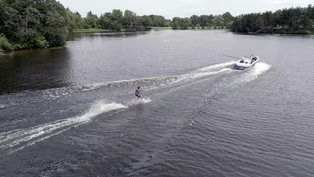
Clip: S17 Ep6 | 9m 46s | In New London, the Learn to Ski program introduces children to the sport of water skiing, (9m 46s)
 New
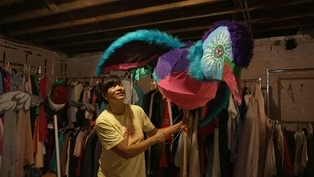
NewLearn to Ski, Dani Prados, Puppet Parade
Preview: S17 Ep6 | 40s | The Learn to Ski program teaches water skiing, artist Dani Prados; and an autumnal celebration. (40s)
 New
NewVideo has Closed Captions
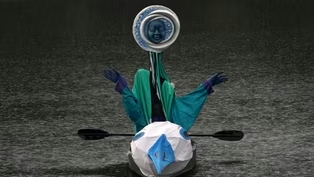
Clip: S17 Ep6 | 9m 7s | In New London, the Puppet Parade brings the community together with an autumnal celebration. (9m 7s)
Providing Support for PBS.org
Learn Moreabout PBS online sponsorship

- Arts and Music
The Best of the Joy of Painting with Bob Ross
A pop icon, Bob Ross offers soothing words of wisdom as he paints captivating landscapes.








Support for PBS provided by:
Postcards is a local public television program presented by Pioneer PBS
Production sponsorship is provided by contributions from the voters of Minnesota through a legislative appropriation from the Arts and Cultural Heritage Fund, Explore Alexandria Tourism, Shalom Hill Farm, West Central...