
WEDU Arts Plus
1508 | Episode
Season 15 Episode 9 | 26m 46sVideo has Closed Captions
Art Restoration in St. Pete | Steampunk Ballet | Indian-American Author | Ukrainian Bandurist Chorus
Discover the craft of art restoration with St. Petersburg art conservator Luis Seixas in a student-produced segment. Plus, experience a unique steampunk Shakespeare ballet in Reno, hear an Ohio author’s perspective as a daughter of Indian immigrants, and enjoy the rich musical traditions of the Ukrainian Bandurist Chorus.
Problems playing video? | Closed Captioning Feedback
Problems playing video? | Closed Captioning Feedback
WEDU Arts Plus is a local public television program presented by WEDU
Major funding for WEDU Arts Plus is provided through the generosity of Charles Rosenblum, The State of Florida and Division of Arts and Culture and the National Endowment for the Arts, and the Hillsborough County Board of County Commissioners.
WEDU Arts Plus
1508 | Episode
Season 15 Episode 9 | 26m 46sVideo has Closed Captions
Discover the craft of art restoration with St. Petersburg art conservator Luis Seixas in a student-produced segment. Plus, experience a unique steampunk Shakespeare ballet in Reno, hear an Ohio author’s perspective as a daughter of Indian immigrants, and enjoy the rich musical traditions of the Ukrainian Bandurist Chorus.
Problems playing video? | Closed Captioning Feedback
Where to Watch WEDU Arts Plus
WEDU Arts Plus is available to stream on pbs.org and the PBS app.
Providing Support for PBS.org
Learn Moreabout PBS online sponsorship- This is a production of WEDU PBS, Tampa, St.
Petersburg, Sarasota.
[music] - Funding for WEDU Arts Plus is provided by Charles Rosenblum, Hillsborough County Board of County Commissioners, the State of Florida, and Division of Arts and Culture, and the National Endowment for the Arts.
In this edition of WEDU Arts, plus the process of preserving works of art.
- The stories we tell with these works of art delve into who we are as human beings and why we exist.
- Dancing to Shakespeare.
- When you start saying everybody's name, it gets really confusing.
And that's why I think when we watch the action, only it can actually be more clear.
- Writing stories and building connections.
- I remember before I could read, looking at my father's handwriting and just being desperate to know what it said, like just desperate to know how to read.
- And a choral and instrumental ensemble.
- This is not just your ordinary choir.
When you come in and sing maybe on Sunday in church, this is a brotherhood, really.
- It's all coming up next on WEDU Arts Plus.
[music] Hello, I'm Dalia Colon and this is WEDU Arts Plus.
This first segment was produced by students at St.
Petersburg College in partnership with WEDU.
Have you ever been to a museum and wondered how are these pieces of art restored and preserved?
The secret is art conservators like Luis Seixas in St.
Petersburg.
We visit the Museum of Fine Arts, St.
Petersburg to learn the craft of art restoration and conservation.
- Museums really work at keeping the past conserved and alive for a variety of reasons.
Why the objects are important goes to what it is to be human.
The stories we tell with these works of art delve into who we are as human beings and why we exist.
They examine a lotof the questions of what our lives mean.
So for me, when we look at the objects included here, it's this larger pageant of history.
And of course, in a world that's just changing every day where truth is oftentimes blurred.
I think museums have a very important role as being bastions of truth and integrity and of history.
And of course, it's an old adage, but those who do not understand their history are doomed to repeat it.
Conservators and the way museums work with them helps ensure not only the preservation of the collection, but the beautiful appearance of the collection as well.
It's a really, really crucial role in museum practice.
There's a saying that if you love.
- What you do, we don't work a single day in your life.
When I realized that I was suited to do something like that, this combination of science, problem solving and dealing with art objects of incredible value, it's just extremely rewarding experience.
And that's why I keep doing it every single day.
The art students and I realized that all my friends going straight to the Accademia of Fine Arts in Lisbon, my hometown in Portugal, we're not having fun.
And I came across, um, a flier about the first degree in art conservation in my country.
And 35 years later, here I am.
So what is a conservator?
Conservator saves all cultural heritage physically.
Trains in the conservation program specialize in particular kinds of material, in my case, sculpture and objects, and adheres to a strict ethical practice in their work that we call, we call the code of ethics.
- There's different forms of art.
He pointed out that he likes more physical media instead of paintings.
I think when we think of conservation, we think of paintings.
but he talks about what bronze sculpture might need.
Um, I, I never think of those things needing conservation because they're metal, they're sturdy, but they, they obviously do.
- I recently asked our contract conservator, Luis Seixas, to conserve our crushed pole, which is a very beautiful object made by an artist of the First Nations, a Canadian artist.
Over time, it's gotten a little bit dirty and a little bit dingy because it's situated outside.
It was made to be shown outside, and the artist, I think, believes that it should deteriorate or live naturally.
And so as part of that process, the paint would weather it would maybe fade a little bit.
But of course, we're an art museum and we want to preserve things in perpetuity.
So I'd ask Luis recently to clean it and to conserve it.
- I'll often.
- A piece.
- Needs maintenance.
It depends on the object.
So outdoor sculpture probably.
And I've been doing conservation of public art for the city of St.
Petersburg.
I've been working for the museum and also here in circumstances where they have the objects in the outdoors exposed to the elements, especially bronzes, they should be at least washed clean that way.
Wax to protect the bronze every six months.
Ideally, objects like this need to be, of course, vacuum cleaned.
Uh, any time that we would see that there's some changes in accumulation of dust, which happens because we have visitors.
So people will bring all these particles and the atmosphere in the museum tries to be as clean as possible.
But there's also it varies depending on the setting and the type of object.
- These are the conservation steps mechanical cleaning, stabilization, solvent testing, chemical cleaning, disinfection or disinfestation.
For biocontrol, 80% of the work is, uh, chemical cleaning.
And I do it with a cotton swab occasionally with a brush.
And these are the main four families of solvents that we use aqueous, uh, detergents and organic solvents and gels when nothing else works.
And yes, we use saliva.
- I think art conservation is a nice combination of two very fundamental human activities science and art.
The way we express ourselves.
But we need to bring in science to conserve and remember and care for those things.
And we're doing it all over the world.
- These are the conservation laws.
First one is respect for the original.
Conservation is not a creative act.
We try to use minimal intervention.
Less is more.
We try to use compatible materials to minimize the changes.
And probably the most important one verse reversibility.
So every treatment and every material use has to be possible to be removed in the future.
We don't aim for perfection.
We aim for a situation that's a specialist or someone that knows the object will be able to recognize what's the original and what's the 21st century restoration.
- One of the things that I think is so crucial for museums is showing how much we all have in common, how the threads that bind us together are together.
Also things that show the commonality of our thought and our cultures across the globe.
So I look at museums as having a very crucial role, and I hope that visitors take a lot away from our institution.
- Conservation is not the goal.
It's just one step in to minimize the damage on the objects.
But the object will likely in the future, will be restored again for concerts.
Both of these objects will overlap.
That's right.
We're going to die.
And this object will be here, so someone will have to take care of them.
So what we do is what it's possible to be done with the knowledge and the materials we have at this point.
[music] - For more on Luis Seixas, visit sercaconservation.org and search his name, see current Exhibitions at mfastpete.org.
The Sierra Nevada Ballet combined Shakespeare, steampunk design and dance to create a production that is one of a kind in this segment.
Travel to Reno, Nevada to see how the show came together.
[music] [music] - Well, Midsummer Night's Dream is a classically complicated story.
Like it's it's one of Shakespeare's plays that people always say, I get confused about this, but.
- We have interpreted it in a different way to add a steampunk element and an ethereal element as well.
[music] - Midsummer Night's Dream has three little sections.
There's a story about a couple, a girl whose father is very, how can we say male chauvinistic?
He wants her to marry the person he wants her to marry, but she doesn't want to marry that person.
She's in love with somebody else.
And she tells her best friend Helena, about the fact that she wants to be with this other person.
Now, Helena loves the person her father wants her to marry, so it becomes a little a little complicated there.
Now they run away.
The two people who want to get married to the forest where the other plot happens, because it's a story about the Queen of the fairies and her husband, who have a strange relationship.
They have a good marriage, but they're always trying to better themselves.
Like.
In other words, if one has strong with strong character, the other one wants to be stronger.
- When you start saying everybody's name, it gets really confusing.
And that's why I think when we watch the action, only it can actually be more clear.
[music] - Ananda spent a lot of time with the actual script of Midsummer Night's Dream, so Ananda is very familiar with the dialogue, which is very helpful when you're trying to translate something without words.
So we were able to go through the scenes and break down what needed to happen in each scene.
And it's great as a choreographer to have somebody who knows the dramaturgy like that, because this is a direct interpretation from Shakespeare.
So it's very important to be able to go back and be like, did we hit the marks we needed to in that scene?
Yes we did.
Let's move on.
- We did the choreography with all of the action from the play having to change certain things, you know, because the dialogue about stuff that happens off stage doesn't work in ballet.
So it has to happen in front of you.
But basically we did the whole Shakespeare play as a ballet.
[music] - For us to translate from words to movement is, is not that difficult.
We use a lot of mime.
- So we will use like, for example, you and I and love.
And so we have hand gestures and pantomime that we rely on.
But you can also interpret that in the body.
So if somebody is uncomfortable, you can see their body language will change to be able to keep continuing that story on.
[music] [music] - One of the goals of our ballet was to help people understand Shakespeare's work a little bit better, a little bit easier.
And I think with the costuming, that was one of the elements we wanted to bring in was that the fairies are fairies, the villagers are villagers, and then the couples are specific couples that do go together.
- Ananda had the great idea that all of the humans in the story are all from the steampunk world.
And so when you see any of the lovers or the royalty, they're all part of this world that we've built that's steampunk.
- And because it has that sort of the Victorian style, even though it's outlandish and amazing and whimsical, it still gives us a feeling more of the everyday and then versus the magical.
[music] - The townspeople, we actually kept to a pretty strict palette of more muted tones.
And the reason why is we wanted to give the audience the impression that the villagers are kind of boxed in.
They don't see the colors, they don't see the otherworldliness that's going on.
And so the fairies, you'll notice, are dressed very boldly in bright colors.
They're all body painted to give it an otherworldly effect so that the audience would recognize these are not the same people.
They don't belong together.
[music] Each individual costume has individual elements to it.
What we tried to do was try to imagine what a street child in Victorian times would have worn, but then add pieces that they would have looked for to be steampunk.
So for a lot of the children's costumes, we added bustles or petticoats under their skirts, but then also added leather corsetry or leather waist pieces, things of that nature to kind of give it that industrial element, but also really stick to that Victorian theme.
[music] [music] - When you build a ballet like this, you want it to all be one cohesive piece and you want it to all make sense.
So that takes a lot of planning with the designers, with the people building the costumes, and then actually trying to take the costumes that you build and make sure they work for the production.
It takes a city.
It takes a lot of people to put on a production like this.
And luckily, we have a wonderful community here that helps support us in that.
[music] - The extraordinary thing is, when they first asked me to do Midsummer, like last year and I started thinking about it, I came up with this idea.
I had this vision in my head and watching this ballet and seeing that it looks exactly like that vision has been so amazing.
I'm like, I can't believe it.
It's real.
That was in my head, and now it's real.
And I'm watching these talented people do all this stuff, you know, and all of this amazing visuals that I hoped we would have, that we do have.
And then the most extraordinary thing for me has been listening to the audience's laughter, not in my scenes, but in the other scenes.
So I can just be there and see the action and hear the like, guffawing laughter.
One audience member told me, she said, I laugh so hard I snort it.
And I was like, that's perfect.
That's exactly what we wanted to happen is that people watch the ballet and they just like, lose it in their seats.
[music] - Discover more at sierranevadaballet.org.
Born and raised in Northeast Ohio, author Jyotsna Sreenivasan writes about the experiences of Indian Americans.
The daughter of Indian immigrants, Sreenivasan writes stories for children and adults and hopes to build connections with her readers.
[music] - Even when I was a little kid, I remember before I could read, looking at my father's handwriting and just being desperate to know what it said, like just desperate to know how to read.
And I was so thrilled when I learned how to read.
I started writing little stories and poems when I was a kid.
[music] One of my first children's novels was called, "Aruna Journeys," and it's about an Indian-American girl growing up in Ohio.
I don't know where I got that idea.
And I wrote it partly because I love to read, and I didn't see any books that represented who I was growing up in Ohio.
I, you know, books about I would see books that were about folktales taking place in India, or I would see books about, you know, elementary kids like the Ramona books, which I loved, or little House in the Big Woods, which I loved.
And I think I almost wrote it for my parents because, you know, growing up, we had a lot of culture clashes.
They didn't understand why I thought I was American.
I am American, and they didn't.
They were like, no, you're Indian.
And so that struggle I couldn't ever get, I couldn't ever communicate that properly to my parents.
So my parents are immigrants.
So they are what I consider the first American generation.
And I'm the child of immigrants.
So I say second generation people.
Some people say that I would be the first generation American, but I like to say second generation because that acknowledges that the immigrant generation is also an American generation.
Um, to me, and I'm biased because I am second generation, the transition from immigrant to American is like one of the foundational stories of our country.
A lot of us share an immigrant heritage, yet a lot of us identify as American.
Where does that transition happen?
And I think a lot of times it happens in the second generation.
Um, we grow up in this country.
We have an American accent.
We don't have the accent that our parents have from, from the ancestral country.
Um, we feel ourselves to be American and sometimes other people looking at us say, no, where are you really from?
And I say, you know, I say, I'm from Ohio.
No.
Where are you really from?
And they're curious.
Um, and so trying to figure out, well, what makes a person American, what does that mean to be American?
Um, and I think that is a struggle that a lot of second generation people go through and that can inform us as we grow older and start to contribute to the society.
[music] So this is my new book.
It's called These Americans, and it's a collection of eight short stories and a novella.
And again, they're all about Indian Americans.
They, um, a lot of the stories take place in the Midwest or in Ohio.
Um, and they're arranged by the age of the second generation character.
So in the very first story, which is called, "Mirror," the new immigrant mom is giving birth to her American daughter.
And it's based on the story that my mom told me about my birth.
[music] I love the cover of this.
So this picture of the mom with the baby that is based on a picture of my mom holding me, that is my mom holding me.
And so then they, the artist flipped it.
And then the idea is that the baby grows up and she has her own child.
So, and the other thing that not a lot of people have noticed is that the colors of the mom's sari are like, kind of like the American flag.
And then the American daughter has colors inspired by the Indian flag.
So the green and the orange like that, so that there's the mixing of the cultures.
[music] I've written a lot of stories that were based on my life, based on the kind of the cultural clash or melding of Indian culture, American culture, Indian American.
What does that mean?
It's hard.
And so I feel like there's been a lot of failure along the way, a lot of learning along the way.
[music] I think the hardest part for me is getting myself out of the way.
Um, because at first I think we're, at least for me, I'm putting it on the page and I'm like, oh, this is so impressive.
Everyone's going to be so impressed with me.
And that is not what you want as a fiction writer, because you want the reader to be involved with your character.
And so for me to be able to learn about who that character is, what they care about, where they are, what they care about in their environment, what they really want.
It took a while to get to that point where the reader was engaged and interested and excited.
And so, um, it's been a long process.
When you read fiction and you become that character, you kind of see the world through that person's eyes.
You understand, you empathize.
So I think that's, um, a really important part of what I hope the reader will get.
[music] - Learn more about the author at Jyotsna srinivasan.com.
The Ukrainian Bandurist Chorus seeks to preserve the culture, music, and history of Ukraine by sharing the bandura instrument with people across the globe.
The group keeps the rich musical traditions of Ukraine alive.
[music] - This is not just your ordinary choir.
When you come in and sing maybe on Sunday in church, this is a brotherhood, really.
And that's that's really what draws people here?
[music] - The Ukrainian Bandurist Chorus passes on a culture through its music.
The group has a 100 year history and at times performing has come with a great cost.
- Governments are very frequently scared of the Bandura and Bandura players because they were the oral history of the nation and of the culture.
They were able to continue talking about historical events that maybe the authorities didn't want people to know about, and it's maybe easier to burn a book.
It's pretty difficult to bury a song or bury an instrument.
[music] - But the music dates back centuries, with traveling performers sharing stories through songs.
After World War I, the Ukrainian government organized a professional chorus, which is the foundation of this group.
- But then the 1930s came, and Stalinist purges, persecutions, imprisonments, jailings, executions and members of our group conductors banned bandura players, singers.
They were imprisoned, sent to Siberia or executed.
- Surviving members performed in World War II displaced persons camps before emigrating with other Ukrainians in mass to the United States.
Many members settled in Detroit, Michigan, and revived the chorus, which continues today with new players and singers from across the U.S.
and Canada.
Andrij Birko is a third generation member.
- It was kind of in my blood to begin with.
My grandfather was actually a bandura player in Zhitomir, Ukraine, which is it's a city a couple of hours from Kyiv, the capital of Ukraine.
And he was a bandura player back home.
And he met up with the Bandurist Chorus in the displaced person camps in Germany.
So that's where he joined.
Then my family, that was on my mom's side, they came over to the United States in the late 40s, and actually my dad, in order to hook my mom, learned to play bass bandura and joined the choir.
[music] - Birko says the bandura is tough to play, and members of his group have to rigorously practice outside of their regular work, as these are unpaid positions.
He describes the instrument as a cross between a lute and a zither.
- So it's a lowercase B that has strings on it.
It has a neck like a guitar, and then it's got a huge belly that sticks out over here.
And unlike a guitar where you press on the frets to make your different notes.
The bandura is in some ways simpler because it's got one string per note.
You know, you play individual strings to hit individual notes, but that also makes it harder because it's got 60 strings or however many is on here.
[music] - There are various ages from we have someone that's 14 that just started with us, and we have gentlemen that are in their mid 70s.
But they all work hard and we create, you know, wonderful experiences, not just music, but more importantly, maybe experiences for us and also for the audience so they can maybe better get a better sense of the history of Ukraine.
That's part of our mission.
We are...we do act as ambassadors.
And in a difficult time for Ukraine, who is at war, and it's being occupied by Russian forces.
We can show another side of Ukraine and kind of be a, have some musical diplomacy in some ways.
- About a dozen members live in Northeast Ohio, including Nazar Karlovacko.
- Whenever a person leaves their home country, they.
They leave a bit of a of their heart behind.
And in addition to family and friends that I left behind, I also left the culture and the music that I. That I love so, so much.
So when I came here, obviously I was seeking to rejoin with the culture and with the music.
[music] - The group travels around the world to perform and has done so for decades, playing everywhere from Severance Hall in Cleveland to the Sydney Opera House in Australia.
- Recognize that building?
That's the Notre Dame Cathedral.
- It is a source of pride for Volodymyr Murha, who moved to the U.S.
with his parents at age two.
- You're sharing something to something that is enticing to the people that you're sharing it with, and it just makes the world a little bit more, I say, a lot more interesting.
[music] - The chorus also fosters education of the instrument in order to keep the traditions alive.
- There are bandura, music schools, private teachers throughout the country, and throughout Canada.
- Birko is one of those bandura teachers.
Passing along the skills and the stories.
- I have to give back this opportunity for.
For the ones you know, the ones up and coming.
And who knows whether we'll still be around in North America a hundred years from now.
But if we're not.
It's not going to be my fault.
And and I just I want this group to continue.
And if it's to continue, there are people that got to do the work.
[music] - Discover more at bandura.org.
And that wraps it up for this episode of WEDU Arts Plus.
To view more, visit wedu.org/artsplus or follow us on social.
I'm Dalia Colon.
Thanks for watching.
[music]
Video has Closed Captions
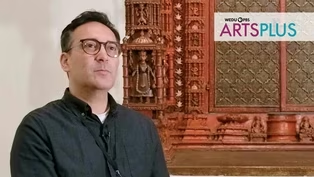
Clip: S15 Ep9 | 5m 46s | Discover art conservation with Luis Seixas at the Museum of Fine Arts, St. Petersburg. (5m 46s)
Providing Support for PBS.org
Learn Moreabout PBS online sponsorship New Episode
- Arts and Music

Innovative musicians from every genre perform live in the longest-running music series.









 New Episode
 New Episode

Support for PBS provided by:
WEDU Arts Plus is a local public television program presented by WEDU
Major funding for WEDU Arts Plus is provided through the generosity of Charles Rosenblum, The State of Florida and Division of Arts and Culture and the National Endowment for the Arts, and the Hillsborough County Board of County Commissioners.