
Wanda Bahmet
Clip: Season 17 Episode 12 | 14m 22sVideo has Closed Captions
Wanda Bahmet shares her story of surviving a WWII Nazi work camp and post life in the United States.
Wanda Bahmet shares her story of surviving a WWII Nazi work camp, and her life in the United States after the war.
Problems playing video? | Closed Captioning Feedback
Problems playing video? | Closed Captioning Feedback
Postcards is a local public television program presented by Pioneer PBS
Production sponsorship is provided by contributions from the voters of Minnesota through a legislative appropriation from the Arts and Cultural Heritage Fund, Explore Alexandria Tourism, Shalom Hill Farm, West Central...
Support provided by:


Wanda Bahmet
Clip: Season 17 Episode 12 | 14m 22sVideo has Closed Captions
Wanda Bahmet shares her story of surviving a WWII Nazi work camp, and her life in the United States after the war.
Problems playing video? | Closed Captioning Feedback
How to Watch Postcards
Postcards is available to stream on pbs.org and the free PBS App, available on iPhone, Apple TV, Android TV, Android smartphones, Amazon Fire TV, Amazon Fire Tablet, Roku, Samsung Smart TV, LG TV, and Vizio.
Providing Support for PBS.org
Learn Moreabout PBS online sponsorship(gentle music) - Wanda's a special person, full stop.
She has a lot to teach us.
At her age, she has seen world history in a front row seat, and she has a survivor's tale of hardship, of near starvation, of forced labor, of relocation multiple times.
And we are blessed in Minnesota to have the years that we have with her.
(gentle music) - My name is Wanda Bahmet.
I was born on February 20th, 1934, in a very large city, very industrial city, Dnipropetrovsk.
Those were happy years in the beginning, and later on, they were not so happy.
(somber music) At that time, Ukraine was under Soviet rule, Soviet meaning Russia.
I lived in Ukraine till the time the Germans took us to Germany.
- Ukraine is a country rich in agriculture, it is rich in metals, in minerals, and it has ideal shipping ports to other parts of the Mediterranean and the world.
So it is a really fabulous piece of real estate that has been coveted and claimed by its neighbors.
(somber music) During the Russian occupation of Ukraine, things were very difficult.
The Russian Empire, which came to be the Union of Soviet Socialist Republics, occupied 11 time zones.
It was geographically enormous, and in that span of time zones were scores of cultures, each having, in many cases, their own language, their own traditions.
And it was a difficult task for anyone to try to keep that whole group moving in the same direction.
So they fell back to authoritarian regimes.
And Joseph Stalin was one of the early purveyors of terror, torture, disappearances, filling the gulags, killing millions of his own people in an effort to instill fear and terror in those who were living underneath his control.
- In my house, two rooms were separated for my grandmother, my father's mother, and then the rest of the rooms, well, we occupied my father, my mother, my sister, and I. That is during pre-war time.
During war time, there were also my aunt and her children were there for short time.
And during the war, Germans occupied my father's drafting room.
And it was a very uncertain time.
And then later on, my aunt was with us with her two children and she told us that grandma was killed by shrapnel.
(bomb exploding) - [Barry] The geopolitics of Ukraine were complicated during World War II.
Adolf Hitler, principally, starting in 1938, began his march across Europe.
And it seemed like the Nazi juggernaut was unstoppable.
(reporter speaking German) (bright music) - The German planes came over us and start shooting.
(Wanda imitating gun) (somber music) So we ran to the bomb shelter.
A bomb shelter was actually a hole in the ground covered by a board and then covered with a little bit of dirt on top.
I didn't make on time.
There was a bomb that exploded and I got deaf.
There were no food.
The stores were closed or pilfered or robbed.
There was nothing to eat.
There were other people that were hiding in our house besides my grandmother and my mother's aunt.
There were people laying on the road that were killed.
Actually during German occupation, if you had a radio, you would go to prison or you could get shot for that.
So you could not listen to what's happening in the war or news.
We were waiting for my mother to join us.
Well the German soldiers said, "There is a train.
Get into the train."
My father said, "Well I'm waiting."
No, all of us had to go and get into the train.
This was train not for people.
This is train that was carrying cattle.
We didn't know where our mother was.
We just had to follow what the orders were.
But orders were under a gun.
You cannot choose what you want to do.
The train would stop at the stops that there was very thinly populated.
And then a couple of days later, we found out that mother was couple... Couple wagons down.
She was actually in the same train.
- There were different types of camps.
We all know about the concentration camps, which were to be the death camps for 6 million Jews, gypsies, gays, political dissidents, and others.
There were displaced persons camps at the end of the war.
And there were also slave labor camps.
As the German war machine cranked up in World War II, young men were taken out of their factory jobs and sent into uniform and off to war by the tens of thousands.
Germany solved this staffing of the factory problem by taking people in lands they had conquered and saying, "You're gonna get on the train, you're gonna take with you what you have in your hands, and we will relocate you.
We're not telling you where, but get on the train."
They went to a camp called Ostarbeiters.
There were many of these, but “ostarbeiters” in German means literally “east workers” or “people from the east” who were conscripted to work in these factories to keep the factories going when the young men had gone off to war.
They worked for no wages, but they had a ration of bread, a place to sleep, and they were not free to come or go.
- Number 37, siebenunddreisig, that's all that I hear, siebenunddreisig, meaning 37.
So all these camps were built next to the factories.
When the factory is bombed, we had to do something in the camp.
Now our parents were working, so there were still some kids and a few elderly people that stayed in the camp.
We were allowed to go to a shelter.
Now we had the English would come and bomb, and then the Americans, there were two bombings a day.
So sometimes we just said, "Okay, what's the use running to the shelter?"
Now as time went on, you cannot really survive for long.
I got very thin and I had big boils that developed on my legs and on my arms.
All of a sudden, there was no bombing.
And what does that mean?
You know, no bombing, quiet.
The camp guards all disappeared.
When the war ended, most of the people did not want to return back to the Soviet Union.
My father would be either shot on the spot or sent to gulag camps.
My mother was very ill at that time.
And the kids, all the kids would go to some kind of reform school.
So there is no reason to return.
(somber music) We were taken to Bremerhaven.
We were put on a boat to come to the United States.
And in 10 days, we were already in New York.
We saw Statue of Liberty.
I decided that I would study chemistry.
I found another school that I wanted to go is this Illinois Institute of Technology.
That was a very excellent school.
After two years or so, I married the guy that I met at the University of Illinois.
After he got master's degree, he looked for a job.
By that time already, I was pregnant with a third child.
He got a job at Macalester College.
So we came to Twin Cities.
Life was sweet and good in the United States.
(gentle music) - There wasn't really anyone playing here in Minnesota, but Wanda, she connected us with people, and even like just getting the instrument itself.
They aren't really like made in America, they're made only in Ukraine.
And Wanda connected us with someone who had a Bandura.
And that's how we got our first Bandura.
Since 2022, we've been just playing a lot in Bandura and also performing.
- Wanda Bahmet was a tutor in Ukrainian language for Angelica and Justin.
And she encouraged them to look at the tradition of the Bandura.
We're too many thousands of miles separated from Ukraine and the human rights and cultural injustices that are being done today.
But it is possible from this distance to do something to keep the torch of Ukrainian culture, history, music, legends alive.
(gentle music continues) (soft music)
 New
NewVideo has Closed Captions
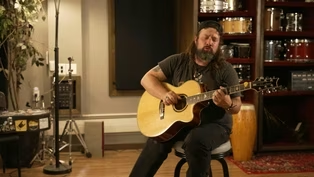
Clip: S17 Ep12 | 15m 36s | In Rochester, roots rock band Clay Fulton and the Lost 40 host a music celebration. (15m 36s)
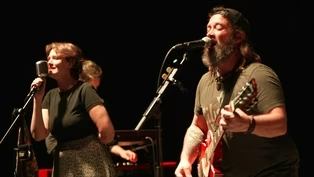
Wanda Bahmet and Clay Fulton and the Lost 40
Preview: S17 Ep12 | 40s | Wanda Bahmet recounts surviving a Nazi work camp; Clay Fulton and the Lost 40 host a music festival. (40s)
Providing Support for PBS.org
Learn Moreabout PBS online sponsorship

- Arts and Music
The Best of the Joy of Painting with Bob Ross
A pop icon, Bob Ross offers soothing words of wisdom as he paints captivating landscapes.











Support for PBS provided by:
Postcards is a local public television program presented by Pioneer PBS
Production sponsorship is provided by contributions from the voters of Minnesota through a legislative appropriation from the Arts and Cultural Heritage Fund, Explore Alexandria Tourism, Shalom Hill Farm, West Central...