State of Affairs with Steve Adubato
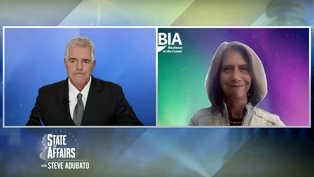
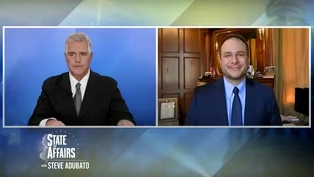
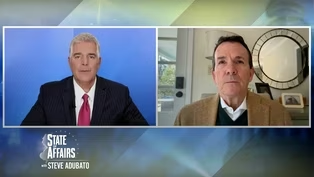
Michele Siekerka; James Solomon; Sen. Declan O’Scanlon
Season 10 Episode 4 | 27m 58sVideo has Closed Captions
Michele Siekerka; James Solomon; Sen. Declan O’Scanlon
Michele N. Siekerka, President and CEO of NJBIA, talks about the impact of Governor Sherrill’s proposed budget on the NJ business community. James Solomon, Mayor of Jersey City, examines the city’s fiscal challenges and the effects of a healthcare desert on residents. Sen. Declan O’Scanlon, Republican Budget Officer, discusses highlights and concerns from Governor Sherrill’s first budget address.
Problems playing video? | Closed Captioning Feedback
Problems playing video? | Closed Captioning Feedback
State of Affairs with Steve Adubato is a local public television program presented by NJ PBS
State of Affairs with Steve Adubato
Michele Siekerka; James Solomon; Sen. Declan O’Scanlon
Season 10 Episode 4 | 27m 58sVideo has Closed Captions
Michele N. Siekerka, President and CEO of NJBIA, talks about the impact of Governor Sherrill’s proposed budget on the NJ business community. James Solomon, Mayor of Jersey City, examines the city’s fiscal challenges and the effects of a healthcare desert on residents. Sen. Declan O’Scanlon, Republican Budget Officer, discusses highlights and concerns from Governor Sherrill’s first budget address.
Problems playing video? | Closed Captioning Feedback
How to Watch State of Affairs with Steve Adubato
State of Affairs with Steve Adubato is available to stream on pbs.org and the free PBS App, available on iPhone, Apple TV, Android TV, Android smartphones, Amazon Fire TV, Amazon Fire Tablet, Roku, Samsung Smart TV, LG TV, and Vizio.
Providing Support for PBS.org
Learn Moreabout PBS online sponsorship- [Narrator] Funding for this edition of State of Affairs with Steve Adubato has been provided by NJ Best, New Jersey’s five-two-nine college savings plan.
The Turrell Fund, a foundation serving children.
The Burke Foundation Kean University.
Where Cougars climb higher.
Horizon Blue Cross Blue Shield of New Jersey.
Operating Engineers, Local 825.
Garden State Initiative NJM Insurance Group.
Serving New Jersey’s drivers, homeowners and business owners for more than 100 years.
And by IBEW Local 102.
Lighting the path, leading the way.
Promotional support provided by ROI-NJ.
Informing and connecting businesses in New Jersey.
And by NJ.Com.
Keeping communities informed and connected.
[INSPRATIONAL MUSIC] - Hey, everyone, Steve Adubato here.
We have our good friend, Michele Siekerka.
She's the president and chief executive officer of the New Jersey Business & Industry Association.
Michele, good to see you once again.
- Always a pleasure, Steve.
- Taping this mid-late March, actually St.
Patrick's Day.
Governor Sherrill, new budget, as we tape recently announced the things you like about it as it relates to the business community that you and NJBIA represent and then some things that you have some concerns about, go ahead.
- Sure, well, first of all, I mean what we like so far in this administration is the focus on process.
And the fact that business has a seat at the table and the fact that this governor recognizes the business community for the job creators that they are.
So, that's a breath of fresh air.
I'd like us to recognize that a budget is a snapshot in time.
And so, the things that we find challenging in this budget, like some of those taxes, you can call them reform, assessments, whatever, it's additional cost on business, we're certainly not happy with that.
And yeah, we're concerned about when it comes to affordability, potentially talking about cuts in property tax relief.
But we're not concerned because we've always known that property tax relief is a rebate check that when there's no money, it's not going to appear.
And we need to talk about property tax reform.
- Okay, go back to the taxes, whether they're called taxes or not, there are certain policies that have been proposed.
By the way, so everybody understands, the governor proposes the budget, the state legislature adopts the budget with, there'll be changes, negotiate, imagine there's negotiating going on in the state house and the governor will sign the budget, or not sign the budget, taking a red pen out and marking things out and they're vetoed.
What are the specific concerns you have about specific proposals in the governor's budget as it relates to taxes or increased costs for business?
- Sure, the net operating loss and the, what they call- - Explain that one, what is that?
- So, basically, this is when companies can take gains in one year and offset those gains by losses that they had in years prior.
And the program is set up for, it's like a 20-year look forward.
So, that program is going on pause for three years.
What we would like to say back to that is then extend the program, the three years on the backend, don't take away the opportunity for these credits to be used, 'cause business has already relied upon that and they're tax-planning for the future.
And Steve, you know predictability and certainty is something that business needs.
So, that's the NOL, that's that first tax concern.
- What's the next one?
- The second is the alternative business calculation, ABC.
It is suggested that the purpose behind this was towards small business, which we don't dispute.
However, this was intentional, again, tax reform that was done well over a decade ago in a bipartisan manner in order to make New Jersey more competitive when it came to corporate tax here in New Jersey.
Now, what the governor's looking to do, is she's basically changing the thresholds, saying she really wants it to be focused on the small business and too many large companies are taking advantage of this.
One of the significant challenges we're concerned that the threshold she's going at is set way too low.
Because someone who has a million dollars in gross operating, that's not a large company, that's still a small business.
We see that every day.
So, we're gonna continue to have discussion, yeah, with the administration on those two.
And the third one is the Medicaid assessment/tax.
- Yeah, what is that?
I'm gonna talk about childcare in a second- - Yeah.
- Shifting gears to our, the Start Strong NJ initiative.
But go back to the Medicaid assessment.
I'm trying to understand.
There's a proposed employee Medicaid assessment, what does that mean?
- So, the challenge with this, is that we're basically saying a certain size company, if they have any part of their workforce, right, over 50 employees that are on Medicaid, we're gonna give them an assessment.
Because they should be paying their healthcare.
Let's start with the fact that an overwhelming majority of- - Give the business an assessment?
- Yes, give the business an assessment, like they're gonna pay a penalty.
They're being punished, because some portion of their workforce is on Medicaid.
So, we want the company to pick up that cost through this assessment, this penalty, this fee.
What is misplaced about this is many, overwhelming majority of these companies have a health benefit plan in place.
So, let's start there.
It's not that they're not providing healthcare for their workforce.
They are.
The challenge is the workforce that we're talking about is the underemployed.
It's pretty much ALICE that you hear or say all the time, Asset Limited, Income Restrained, Employed, right?
The underemployed, this population oftentimes can only work a certain number of hours that disallows them to meet the eligibility requirement of 30 hours to get on that health benefit.
Because they have childcare issues, they have transportation issues- - Yep.
- They do, they work different jobs to support their station in life.
I mean, that's real.
We've talked about this population with the United Way and the homeless shelters forever.
How do we help this particular population more than we can?
It's not by assessing those who employ them.
In fact, those employers do their best to provide and extend benefits.
And oftentimes, that workforce doesn't come to enough hours to be eligible.
- Let's talk childcare.
And let me also say that NJBIA, New Jersey Business & Industry Association, has a publication called "New Jersey Business" and we are cross-promotional media partners in that.
Along these lines of childcare, Start Strong NJ, the website's up right now, you know what the initiative is.
Explain to folks, Michele, the very direct and impactful impact, which is redundant, the impact of not having accessible, affordable, quality childcare on the New Jersey regional and national economy.
- Yeah, so, look, we need a workforce that can come to work secure when they show up to be productive, efficient and effective and to be able to show up, which means their family needs to be in a safe place, which means if you have children, they need access and affordable childcare.
So, those children can be placed in a safe environment.
We learned, even pre-COVID, the challenges we have in our childcare industry here in the state of New Jersey around accessibility and affordability, we were already on it, but the bandaid was ripped off during COVID.
And since then, we've been running a marathon to see how do we get more attention to this industry, so they can open up more spaces, so that our children can be in safe places and get our parents to work.
- But if we do not do it as described and to the degree it's necessary, it will have an adverse impact on the economy, because those parents can't work.
- Correct, they don't come to the workforce, which means they don't earn wages, which mean we can't tax those wages, right?
And holds them back.
And also, obviously, many times, this has a truly disparate treatment of women.
Because women tend to be the one who will stay back first.
We saw that again coming out of COVID, women were the last to return to the workforce for these express issues.
And also, that's what leads to lack of parity in wage.
When someone has to step out, if they're out for one, two, three years, 'cause they don't have childcare and they're staying home with their children, when they come back, their wages have been suppressed.
And we gotta pick up from there.
- Michele Siekerka is the president and CEO of the New Jersey Business & Industry Association.
Michele, as always, great conversation, talk to you soon.
- Thanks so much, Steve.
- You got it.
Stay with us, we'll be right back.
(grand music) - [Announcer] To see more State of Affairs with Steve Adubato programs, find us online and follow us on social media.
- We are honored to have the honorable mayor of Jersey City, James Solomon.
Mayor, great to have you with us.
- Thank you, Steve, for having me.
- You got it.
Mayor, let's jump into this and it will not be the last time we have you on because Jersey City is the second largest.
And I know you may be, you think about being the largest at one point, but Newark is the largest Jersey City second.
This is part of our series, "Urban Matters," whole range of issues I wanna talk about, first is this.
You have a budget crisis in Jersey City.
Is that a fair description mayor?
- Absolutely.
It's $254 million, nearly 30% of our budget, 13 times the size of New York City's crisis, larger than the size of our police and fire department salaries.
- How the heck does that happen all of a sudden?
- Yeah, you know, the former administration, you know, made a choice to cover up a lot of budget ailments and ills.
They use a lot of one-time gimmicks to plug budget holes.
So $33 million in land sales, $27 million out of a rainy day fund.
And then on top of that, they systemically under budgeted our healthcare costs and they left us with $52 million in unpaid health bills from 2024 and 2025, as well as an additional $50 million in healthcare costs.
So when you add that all up, that's how unfortunately, we get to a deficit of this size and magnitude.
- So in addition to you pledging only taking a $1 salary in 2026, which is symbolic but significant and put up the website to find out more information about the budget and budget transparency in Jersey City.
But Mayor, let me ask you this.
Are you ultimately expecting the state of New Jersey who's also facing, we just had the governor, we interviewed her for a half hour check, out that program.
Are you expecting the state to come in and, dare I use the phrase, bailout Jersey City?
- So we are asking for a partnership with the state in the short-term.
And the reason why we think that makes sense is Jersey City's economic growth has been extraordinary benefit to the taxpayers of the whole state.
We've added hundreds of millions of dollars in taxpayer revenue by growing so substantially as we have.
And the last thing that the entire state of New Jersey needs is for Jersey City to reverse course, for property taxes and service cuts to basically stop growth in Jersey City, stop development.
We've really been an economic engine for the whole state.
So what we've said to Governor Cheryl, as well as our partners in the legislature is, you know, one year, one time, we need some assistance.
We need that assistance to prevent the working in middle class families of Jersey City from suffering from the former mayor's mistakes.
And we need that assistance to get back on our feet, but we are not looking for a long-term set of assistance.
We just need it in the short-term.
And the other thing that I think is, you know, really important to emphasize here is that, you know, we can get back to stability, to economic growth very, very quickly.
- All right, let's shift gears dramatically.
A good friend of mine happens to be, and we talked about this before we got on the air, your head of public safety is Anthony Ambrose.
Is he the head of public safety?
- Yes.
Director of public safety.
- Well, he is a great law enforcement professional, not just a friend, but I know that about him.
And check out who Anthony Ambrose is, his former work in the city of Newark.
And here's what I keep thinking.
For your police department, for the county police, when ICE comes in, the feds come in and Jersey City has a large immigrant population.
The videos there, our friends and partners at NJ Spotlight News have documented this.
There are reports on it.
When ICE comes in to deport, who the heck is in charge?
Is it the feds because the feds are in charge?
A and B, are your law enforcement professionals supposed to cooperate with them or can they resist them if they think something's happening that's unconstitutional or illegal?
I know that's a loaded question, but we're trying to figure this out and we'll also have the Attorney General of New Jersey come on and talk about it as well.
Go ahead, mayor.
- Well, it's a phenomenal question to ask and part of our deep concern is that the way ICE is operating actually pits local and federal law enforcement against each other in situations that could be dangerous.
And we are actually teaching our officers and training them to deescalate in those situations 'cause we do not want conflict between federal and local law enforcement.
What we have said to ICE very clearly is if you have a criminal signed warrant, we will cooperate, we will help you.
But if you don't have that, we don't want you operating in Jersey City.
Now, I can't prevent them from doing so, but unfortunately what they're doing is oftentimes, they'll operate without giving us any advanced notice, then we'll get 911 calls, people saying, "Look, "these people in an unmarked vehicle "are taking one of my neighbors and putting them inside," so people don't know that this is an actual law enforcement activity.
And that situation creates danger.
So our core message is really to President Trump, to Homeland Security.
I guess they're having a new director soon, is reform your tactics, reform your work.
You know, what we want here is just go after folks that have, again, those criminal warrants and leave the kind of hardworking immigrants alone.
Don't engage in these tactics that can really put our community at risk.
- Mayor, you believe this is dangerous?
- Absolutely.
You know, I think we saw it in Minnesota, you know, obviously you saw two, you know, protestors killed.
But I think you saw very dangerous interactions between law enforcement and local police where sometimes the local police were in between ICE and the protestors and, you know, we're lucky those situations didn't even get worse than we saw.
So my hope is that the federal government really rethinks its whole approach here.
- Serious crisis and challenge you have in Jersey City, healthcare.
- Yep.
- Heights University Hospital as we speak, we're taping this program on the 17th of March.
Things will evolve, but right now, as of right now, that hospital, one of only two hospitals in Jersey City.
The other is Jersey City University Hospital, right?
- Jersey City Medical Center.
- Jersey City, I apologize, Jersey City Medical Center, part of RWJBarnabas Health.
- Correct.
- To disclose one of our longtime underwriters.
Heights University Hospital is closing.
What does that mean to the people of Jersey City?
A and B, what the heck can you do about it?
Because it's a private organization, they say, "We don't have the money, we're tapping out, we're out."
- Yeah.
What it means, unfortunately, is that the health of my residents is going to suffer.
We should have more than one emergency department in a city of 300,000 people.
Unfortunately, you know, Heights University Hospital, formerly Christ Hospital owned by Hudson Regional Health, you know, that company engaged in truly bad faith actions.
They purchased that hospital out of bankruptcy a year ago.
And at the time, they promised us that they were gonna return wonderful healthcare to the Heights.
And then about, you know, three or four months ago, they shut down the hospital except for the emergency department illegally.
And then just this last week, they shut down the emergency department.
The state has a legal process by which you're allowed to close a hospital.
HRH flouted it.
They, they just said, "The law doesn't matter to us.
"If we want to close this tomorrow, "we're gonna close it tomorrow."
And that type of behavior is I think what gets ordinary residents so angry with corporations where they just see that like, "If I have to follow the law, if I'm held accountable, "why do these corporations think that they can't?"
And we really, you know, wanted the state to file an injunction to keep them open.
The state chose not to.
We tried, the courts did not rule in our favor.
But for me, the next step is twofold.
One is use all of my tools to get healthcare back to the Heights.
One of which could be eminent domain.
The public purpose is healthcare.
We may be looking at that at the Heights University site.
And then the second is to partner with reliable healthcare organizations, healthcare organizations you can trust to bring more healthcare back to the Heights, including an emergency department and additional care facilities in Jersey City.
Because, you know, take Newark, similar city of a similar size has three hospitals.
We have one.
And I think anybody can acknowledge that's not acceptable.
So we need a solution.
And the people of Jersey City have, I promise, we're working every day to create one.
- Mayor of Jersey City is James Solomon.
This will not be the last time we have him as part of our series "Urban Matters."
Mr.
Mayor, thank you so much for joining us, wish you all the best.
- Thank you so much for having me.
- You got it.
Stay with us, we'll be right back.
(grand music) - [Announcer] To see more State of Affairs with Steve Adubato programs, find us online and follow us on social media.
- We're joined once again by Senator Declan O'Scanlon, Republican Budget Officer.
Good to see you, Senator.
- Good to see you, Steve.
How's it going?
- Things are great.
By the way, we're taping on March 17th, St.
Patrick's Day.
Special day for you?
- Your audience is the only thing standing between me and the first Guinness so let's get this going here.
You have another 30 seconds before I run out.
- I got it.
It'll be seen later, but here we go.
Do this for us.
The governor's $60.7 billion budget.
Tell us a couple things you like about it and then some concerns, Senator.
- Just in general, the inclination on the part of the governor certainly rhetorically to start living within our means.
Removal of a lot of one shot pork items is a good thing.
The real question will be at the end what's built back in.
Legislative leadership has grown a little bit addicted to these one to $2 billion increases in spending after a governor has put a budget out and that happened the last few years.
So we'll have to see.
The proof will be in the pudding.
But I like that.
- Before you go to the next thing you like, is one of the reasons you don't like those items, those spending items, is one of the reasons, Senator, because they go to Democratic- - No.
- No, no, no.
Let me finish.
Let me finish.
- I know exactly what you're gonna ask.
- Hold on.
If you were in charge and Republicans are in charge of the Senate and the assembly, and you got those perks, you got things for your district that help your constituents, would you be so against them?
- Not in a million years.
I would be against them.
- Okay.
- Because, otherwise I'm hypocrite.
And look, the proof is in the pudding.
I talk to my own members who have projects in their districts and I tell 'em, we have no legitimacy if we're gonna play this game.
Now look, I've got senators on the other side of the aisle.
They claim that they care about fiscal prudence and they say that but they're giving out pork anyway, so I'm gonna take it.
Well, that is a moral judgment that they make.
But when Republicans are in charge, God willing, I'm still here, I will be back on your show.
God willing, you're still here as well.
And there'll be billions in less pork, I promise.
- What's the second thing you like about the governor's budget?
- Again, rhetorically, and it isn't just budgetarily, but the idea that she's gonna cut red tape, expedite permitting.
So rhetorically, those are things I like.
- What don't you like?
- Well, we're not making a lot of progress.
- Are there are more things you like?
- There's the few things.
Let's not get carried away.
We gotta focus on what we can make better.
- Okay.
- We still have a three to $4 billion structural deficit.
We have now discovered that the governor a few weeks ago admitted Republicans were right saying that we had at least a $3 billion structural deficit.
Republicans said four.
In her budget, this is one thing I like about her budget, she confirms that Republicans were right.
We have a $4 billion problem 'cause if you look at this budget overarchingly, we increased spending by around 2 billion, not quite, but around.
We increased taxes by around 2 billion.
Not quite, but around.
That's a wash.
We're spending our surplus by 2 billion, which is troubling.
So our structural deficit is still at least 2 billion, which means if she's saying that we cut it in half, it was four.
But then she has 2 billion in supposed cuts, which we could talk about.
Not really.
A bat to those things aren't real cuts.
So we are probably still between three and $4 billion in structural deficit.
That's a thing I don't like.
- But she's very specific and think about this, and you understand the legislature more than most.
She was right in front of, or right behind her was assembly speaker, Craig Coughlin, who I also interviewed today.
He's the author of the Stay NJ program.
That is a program that attempts to keep people in the state, seniors in the state.
I believe it's if you earn less than $500,000, you get up to a $6,500 tax rebate.
The governor says no, that number should go from a half a million dollars, right?
$500,000 to 250,000.
- 250.
- And above that you get nothing.
And from $6,500 to 4,000.
That's a real proposed cut.
A and B. Do you think that she'll be able to convince the Democrats?
- Well, I'm gonna disagree with your premise.
That is a reduction of tax relief, which means it's a tax increase.
I included that on my $2 billion of tax.
- You said spending, Senator.
It's a cut in spending.
- It's a tax increase.
So hold on a second.
So if you had income taxes were at 10% just for the sake of argument and you cut 'em to 5% and 10 years later, you increase it back up to 10%, that's a tax increase.
This was tax relief that you are cutting.
It's a tax increase, but there's no question about it.
- So you would keep it the way it is?
- I would say cutting tax relief should be the last thing that you're gonna go after.
You want to cut real government expenses.
- Such as?
- Look, Republicans have put out billions in savings.
You could do prospective pension and health benefits reforms which could save you over time more than a billion dollars.
- Isn't she talking about healthcare?
She's talking about health benefits change.
Isn't she talking about health benefits?
- She is not talking much about health benefits.
They are gonna try to bail out their increasing spending on the state program but we haven't seen any real reforms so we don't know what's gonna happen there.
The state health benefits program is in a death spiral and it still is.
The governor wouldn't even deny that even with this budget.
So, no, I disagree with the premise of that cutting tax relief is not a tax increase.
I don't think there's any other argument.
I don't understand that.
- What about state funding to public schools, the state schools?
- So hold up.
Just real quick back on this until you agree with me here.
- Right.
- Let's say we eliminated, I'm not recommending this, we eliminated all property tax relief.
Would you say that's a tax increase or a spending cut?
- That's a tax increase.
- Thank you.
So I think the same thing goes with Stay NJ.
A promised tax relief that you're cutting is a tax increase.
So at any rate, that's a thing I don't like about it.
- What's the biggest change you would make in the state school funding formula?
Because there are a bunch of winners and a lot of losers, please.
- And this is a big area where we have a problem.
They should have fixed this during this budget process.
I realized it was compact and I like the governor by the way, I should state that.
I'm really forming a good relationship with her.
But my job is to make the budget better and to criticize where we make mistakes.
The school funding forum is a mess.
It cuts or doesn't keep up with inflation for half the school districts.
A lot of those school districts are choking on fumes.
I mean really cutting all extracurricular activities, increasing class size dramatically.
It's a problem.
And there's easy ways to fix it with tweaks to the funding formula.
And by the way, we'll just undo changes they're making to the formula.
One of the things they're doing is not abiding by the formula, Capping increases to districts that had massive decreases over the past few years.
Just undo that.
For about 50 million, 75 million, you could really dramatically improve conditions in these districts.
They should have done that.
And I'm in contact with the Board of Education, the state board now to make sure that happens.
- Senator Declan O'Scanlon, Republican Budget Officer.
It is a special day for many New Jerseyans, particularly for him today.
Are you going to have a Guinness right now?
- I am gonna have a Guinness right now.
I'm gonna go see my family.
I'm gonna go see some friends.
Great traditions.
Great traditions.
- And that would mean your work as a senator is over today.
- Oh no.
When I end up at my family or at the bar, everybody's gonna talk policy.
It's gonna happen.
Everywhere I go, it's 24/7, but I like it so it's all good.
And over- - Thank you, Senator.
- It's easy.
- Thank you, Senator.
Appreciate it.
I'm Steve Adubato.
That's Senator O'Scanlon.
And this, we're taping on St.
Patrick's Day.
It'll be seen later.
Happy St.
Patrick's Day after the fact to everyone.
I'll see you next time.
- [Narrator] State of Affairs with Steve Adubato is a production of the Caucus Educational Corporation.
Funding has been provided by NJ Best, New Jersey’s five-two-nine college savings plan.
The Turrell Fund, a foundation serving children.
The Burke Foundation Kean University.
Horizon Blue Cross Blue Shield of New Jersey.
Operating Engineers, Local 825.
Garden State Initiative NJM Insurance Group.
IBEW Local 102.
And by these public spirited organizations, individuals and associations committed to informing New Jersey citizens about the important issues facing the Garden State.
Promotional support provided by ROI-NJ.
And by NJ.Com.
- At the Turrell Fund, we know that all New Jersey families deserve access to affordable, high quality childcare.
Early childhood education supports healthy brain development and provides essential support to power the economy, enabling parents to work, businesses to operate, and communities to thrive.
The Turrell Fund is proud to be part of Start Strong NJ, a statewide initiative to put affordable, high quality childcare within reach of all New Jersey families.
Learn more at TurrellFund.org and StartStrongNJ.org.
 New
NewCEO of NJBIA talks about Governor Sherrill's proposed budget
Video has Closed Captions
Clip: S10 Ep4 | 9m 31s | CEO of NJBIA talks about Governor Sherrill's proposed budget (9m 31s)
 New
NewMayor, Jersey City, examines fiscal challenges & immigration
Video has Closed Captions
Clip: S10 Ep4 | 9m 52s | Mayor, Jersey City, examines fiscal challenges & immigration (9m 52s)
 New
NewSen. O’Scanlon analyzes Governor Sherrill's budget address
Video has Closed Captions
Clip: S10 Ep4 | 9m 54s | Sen. O’Scanlon analyzes Governor Sherrill's budget address (9m 54s)
Providing Support for PBS.org
Learn Moreabout PBS online sponsorship
- News and Public Affairs

Top journalists deliver compelling original analysis of the hour's headlines.

- News and Public Affairs

Today's top journalists discuss Washington's current political events and public affairs.











Support for PBS provided by:
State of Affairs with Steve Adubato is a local public television program presented by NJ PBS