State of Affairs with Steve Adubato
CEO of NJBIA talks about Governor Sherrill's proposed budget
Clip: Season 10 Episode 4 | 9m 31sVideo has Closed Captions
CEO of NJBIA talks about Governor Sherrill's proposed budget
Steve Adubato talks with Michele N. Siekerka, President and CEO of New Jersey Business & Industry Association, about the impact of Governor Sherrill’s proposed budget on the NJ business community.
Problems playing video? | Closed Captioning Feedback
Problems playing video? | Closed Captioning Feedback
State of Affairs with Steve Adubato is a local public television program presented by NJ PBS
State of Affairs with Steve Adubato
CEO of NJBIA talks about Governor Sherrill's proposed budget
Clip: Season 10 Episode 4 | 9m 31sVideo has Closed Captions
Steve Adubato talks with Michele N. Siekerka, President and CEO of New Jersey Business & Industry Association, about the impact of Governor Sherrill’s proposed budget on the NJ business community.
Problems playing video? | Closed Captioning Feedback
How to Watch State of Affairs with Steve Adubato
State of Affairs with Steve Adubato is available to stream on pbs.org and the free PBS App, available on iPhone, Apple TV, Android TV, Android smartphones, Amazon Fire TV, Amazon Fire Tablet, Roku, Samsung Smart TV, LG TV, and Vizio.
Providing Support for PBS.org
Learn Moreabout PBS online sponsorship[INSPRATIONAL MUSIC STING] - Hey, everyone, Steve Adubato here.
We have our good friend, Michele Siekerka.
She's the president and chief executive officer of the New Jersey Business & Industry Association.
Michele, good to see you once again.
- Always a pleasure, Steve.
- Taping this mid-late March, actually St.
Patrick's Day.
Governor Sherrill, new budget, as we tape recently announced the things you like about it as it relates to the business community that you and NJBIA represent and then some things that you have some concerns about, go ahead.
- Sure, well, first of all, I mean what we like so far in this administration is the focus on process.
And the fact that business has a seat at the table and the fact that this governor recognizes the business community for the job creators that they are.
So, that's a breath of fresh air.
I'd like us to recognize that a budget is a snapshot in time.
And so, the things that we find challenging in this budget, like some of those taxes, you can call them reform, assessments, whatever, it's additional cost on business, we're certainly not happy with that.
And yeah, we're concerned about when it comes to affordability, potentially talking about cuts in property tax relief.
But we're not concerned because we've always known that property tax relief is a rebate check that when there's no money, it's not going to appear.
And we need to talk about property tax reform.
- Okay, go back to the taxes, whether they're called taxes or not, there are certain policies that have been proposed.
By the way, so everybody understands, the governor proposes the budget, the state legislature adopts the budget with, there'll be changes, negotiate, imagine there's negotiating going on in the state house and the governor will sign the budget, or not sign the budget, taking a red pen out and marking things out and they're vetoed.
What are the specific concerns you have about specific proposals in the governor's budget as it relates to taxes or increased costs for business?
- Sure, the net operating loss and the, what they call- - Explain that one, what is that?
- So, basically, this is when companies can take gains in one year and offset those gains by losses that they had in years prior.
And the program is set up for, it's like a 20-year look forward.
So, that program is going on pause for three years.
What we would like to say back to that is then extend the program, the three years on the backend, don't take away the opportunity for these credits to be used, 'cause business has already relied upon that and they're tax-planning for the future.
And Steve, you know predictability and certainty is something that business needs.
So, that's the NOL, that's that first tax concern.
- What's the next one?
- The second is the alternative business calculation, ABC.
It is suggested that the purpose behind this was towards small business, which we don't dispute.
However, this was intentional, again, tax reform that was done well over a decade ago in a bipartisan manner in order to make New Jersey more competitive when it came to corporate tax here in New Jersey.
Now, what the governor's looking to do, is she's basically changing the thresholds, saying she really wants it to be focused on the small business and too many large companies are taking advantage of this.
One of the significant challenges we're concerned that the threshold she's going at is set way too low.
Because someone who has a million dollars in gross operating, that's not a large company, that's still a small business.
We see that every day.
So, we're gonna continue to have discussion, yeah, with the administration on those two.
And the third one is the Medicaid assessment/tax.
- Yeah, what is that?
I'm gonna talk about childcare in a second- - Yeah.
- Shifting gears to our, the Start Strong NJ initiative.
But go back to the Medicaid assessment.
I'm trying to understand.
There's a proposed employee Medicaid assessment, what does that mean?
- So, the challenge with this, is that we're basically saying a certain size company, if they have any part of their workforce, right, over 50 employees that are on Medicaid, we're gonna give them an assessment.
Because they should be paying their healthcare.
Let's start with the fact that an overwhelming majority of- - Give the business an assessment?
- Yes, give the business an assessment, like they're gonna pay a penalty.
They're being punished, because some portion of their workforce is on Medicaid.
So, we want the company to pick up that cost through this assessment, this penalty, this fee.
What is misplaced about this is many, overwhelming majority of these companies have a health benefit plan in place.
So, let's start there.
It's not that they're not providing healthcare for their workforce.
They are.
The challenge is the workforce that we're talking about is the underemployed.
It's pretty much ALICE that you hear or say all the time, Asset Limited, Income Restrained, Employed, right?
The underemployed, this population oftentimes can only work a certain number of hours that disallows them to meet the eligibility requirement of 30 hours to get on that health benefit.
Because they have childcare issues, they have transportation issues- - Yep.
- They do, they work different jobs to support their station in life.
I mean, that's real.
We've talked about this population with the United Way and the homeless shelters forever.
How do we help this particular population more than we can?
It's not by assessing those who employ them.
In fact, those employers do their best to provide and extend benefits.
And oftentimes, that workforce doesn't come to enough hours to be eligible.
- Let's talk childcare.
And let me also say that NJBIA, New Jersey Business & Industry Association, has a publication called "New Jersey Business" and we are cross-promotional media partners in that.
Along these lines of childcare, Start Strong NJ, the website's up right now, you know what the initiative is.
Explain to folks, Michele, the very direct and impactful impact, which is redundant, the impact of not having accessible, affordable, quality childcare on the New Jersey regional and national economy.
- Yeah, so, look, we need a workforce that can come to work secure when they show up to be productive, efficient and effective and to be able to show up, which means their family needs to be in a safe place, which means if you have children, they need access and affordable childcare.
So, those children can be placed in a safe environment.
We learned, even pre-COVID, the challenges we have in our childcare industry here in the state of New Jersey around accessibility and affordability, we were already on it, but the bandaid was ripped off during COVID.
And since then, we've been running a marathon to see how do we get more attention to this industry, so they can open up more spaces, so that our children can be in safe places and get our parents to work.
- But if we do not do it as described and to the degree it's necessary, it will have an adverse impact on the economy, because those parents can't work.
- Correct, they don't come to the workforce, which means they don't earn wages, which mean we can't tax those wages, right?
And holds them back.
And also, obviously, many times, this has a truly disparate treatment of women.
Because women tend to be the one who will stay back first.
We saw that again coming out of COVID, women were the last to return to the workforce for these express issues.
And also, that's what leads to lack of parity in wage.
When someone has to step out, if they're out for one, two, three years, 'cause they don't have childcare and they're staying home with their children, when they come back, their wages have been suppressed.
And we gotta pick up from there.
- Michele Siekerka is the president and CEO of the New Jersey Business & Industry Association.
Michele, as always, great conversation, talk to you soon.
- Thanks so much, Steve.
- You got it.
Stay with us, we'll be right back.
- [Narrator] State of Affairs with Steve Adubato is a production of the Caucus Educational Corporation.
Funding has been provided by NJ Best, New Jersey’s five-two-nine college savings plan.
The Turrell Fund, a foundation serving children.
The Burke Foundation Kean University.
Horizon Blue Cross Blue Shield of New Jersey.
Operating Engineers, Local 825.
Garden State Initiative NJM Insurance Group.
IBEW Local 102.
And by these public spirited organizations, individuals and associations committed to informing New Jersey citizens about the important issues facing the Garden State.
Promotional support provided by ROI-NJ.
And by NJ.Com.
- At the Turrell Fund, we know that all New Jersey families deserve access to affordable, high quality childcare.
Early childhood education supports healthy brain development and provides essential support to power the economy, enabling parents to work, businesses to operate, and communities to thrive.
The Turrell Fund is proud to be part of Start Strong NJ, a statewide initiative to put affordable, high quality childcare within reach of all New Jersey families.
Learn more at TurrellFund.org and StartStrongNJ.org.
 New
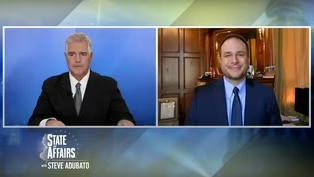
NewMayor, Jersey City, examines fiscal challenges & immigration
Video has Closed Captions
Clip: S10 Ep4 | 9m 52s | Mayor, Jersey City, examines fiscal challenges & immigration (9m 52s)
 New
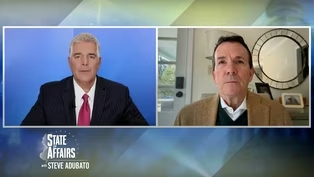
NewSen. O’Scanlon analyzes Governor Sherrill's budget address
Video has Closed Captions
Clip: S10 Ep4 | 9m 54s | Sen. O’Scanlon analyzes Governor Sherrill's budget address (9m 54s)
Providing Support for PBS.org
Learn Moreabout PBS online sponsorship
- News and Public Affairs

Top journalists deliver compelling original analysis of the hour's headlines.

- News and Public Affairs

Today's top journalists discuss Washington's current political events and public affairs.











Support for PBS provided by:
State of Affairs with Steve Adubato is a local public television program presented by NJ PBS