
Here and Now
Justin Sydnor on Prediction Markets, Politics and Elections
Clip: Season 2500 Episode 2516 | 5m 50sVideo has Closed Captions
Justin Sydnor on the growth of prediction markets to place bets on elections and politics.
Wisconsin School of Business risk management and insurance professor Justin Sydnor considers questions raised by the growth of prediction markets to place bets on elections and other political events.
Problems playing video? | Closed Captioning Feedback
Problems playing video? | Closed Captioning Feedback
Here and Now is a local public television program presented by PBS Wisconsin
Here and Now
Justin Sydnor on Prediction Markets, Politics and Elections
Clip: Season 2500 Episode 2516 | 5m 50sVideo has Closed Captions
Wisconsin School of Business risk management and insurance professor Justin Sydnor considers questions raised by the growth of prediction markets to place bets on elections and other political events.
Problems playing video? | Closed Captioning Feedback
Where to Watch Here and Now
Here and Now is available to stream on pbs.org and the PBS app.
Providing Support for PBS.org
Learn Moreabout PBS online sponsorship>> Prediction markets are continuing to grow in popularity expanding outside of sports betting and into politics.
At its most basic, a prediction market allows peer to peer wagers on the likelihood of any kind of event happening.
And as these platforms like Kalshi and Polymarket grow, experts are weighing the pros and cons of aggregate betting on elections.
Producer Marissa Wojcik sat down with Justin Sydnor, a Wisconsin School of Business professor specializing in risk management.
For Moore.
We should note in Wisconsin, it is illegal to bet on an election.
You are voting in.
>> These have been around for a while before recently exploding.
>> Yeah.
So, you know, they date back decades.
Actually, one of the first ones started in Iowa actually as kind of an academic thing where they were trying to predict election outcomes.
So they've been around for a very long time.
They've been studied by academics, but they've really exploded in popularity in the last two years with the advent of listing sports contracts, basically sports betting enabled on these markets.
>> However, now that sports has popularized it, it's now blending back into other world events.
>> Yeah.
So, you know, they've these sort of markets have long existed to let you bet on elections or economic outcomes.
Other political movements.
But I think because of sports betting making them so popular, they've brought in a lot of people who participate on these markets, who now also place some bets on things other than sports that they might not have bet on historically.
And so what that means is that a lot of things like elections have much bigger market volume than they ever historically did.
So it's much more possible to make a lot of trades and potentially have a lot of money at stake on these outcomes in a way that wasn't true even a couple of years ago.
>> Is it dangerous for a Polymarket to be weighing in on elections?
>> I think it's it's not necessarily dangerous, but you need to interpret it through the lens of the market that basically there's a price and it's based on what people think and are willing to place their bets behind at any given point in time.
And that price and those beliefs can change.
And so there's nothing locked into stone and there's no magic sauce to it.
You don't really have a crystal ball.
What you have is a way of aggregating what a bunch of people happen to think at that moment in time.
>> Is it possible for more nefarious actors to manipulate the market to achieve potentially a better outcome for a candidate?
>> Yeah.
>> So, you know, I don't think we have to worry hugely about manipulating the prices in most of these markets.
So as particularly in markets that lots of people are placing bets in and following to move the price in the market.
So move people's beliefs in the market, likelihood of an outcome happening.
You really have to put a lot of money at stake.
So you're going to have to buy a ton of contracts on your favorite candidate.
If you want to move that price.
And ultimately, it's a pretty expensive and risky thing to do because if they don't end up winning, you're going to lose that money over time.
And so I don't think that's the major risk.
But I think the bigger risks are that there's risks of insider trading information.
So if you're participating in these markets, you really have to worry what people on the other side of the bet may know that you can't know.
And we have seen some really high profile cases of insider trading.
I think we also have to worry a little bit that these markets create incentives, potentially for people to try to manipulate the real outcomes of things.
So when you have betting markets behind events that aren't just random events that are going to happen one way or another, but where somebody or some entity could control the outcome, you now may be amplifying the incentives to manipulate those outcomes.
>> And because it's a market, it's always moving forward and changing.
And so it's different than a poll.
>> Yes.
So, you know, it's somewhat similar to polls in the fact that, you know, if you think about polling for any election, we tend to conduct many polls over time because we recognize that news come out, sentiment changes.
And, you know, there are lags in polls.
What mark, what these prediction markets have as an advantage potentially, is that they can react much more quickly to news.
So as an information source about what people are thinking and how important various events or news items were, they can be more informative because they do change minute by minute.
The price on these markets is moving.
>> And is there a chance that they're more accurate because potentially more people are weighing in and they have to put money behind what they're saying?
>> Yeah.
So there's, you know, some good research suggesting that relative to some other ways of trying to forecast the likelihood of uncertain events, that there are some attractive features of these markets and that on average, they can often be a little bit more accurate than some other techniques, and certainly more accurate than typically any one individual's estimate might be.
You know, they benefit from leveraging the information of a lot of people.
And so biases tend to get somewhat muted by lots of people participating.
And the betting feature, the putting money behind the those, those predictions, if you will, does put extra weight for people who are more confident in the outcome.
Now, whether that leads to accuracy really kind of depends whether those confident bettors, the people willing to put their money behind, have better information and better insight about what's going to happen.
I think sometimes that's true.
Other times these markets, you know, there's just not good information out there.
And in those instances, there's no reason to believe that they're going to be particularly good at making an accurate likelihood assessment.
>> Well, thank you so much.
>> Thanks.
Thanks for having.
>> Me.
>> On November 3rd, joined Shawn Johnson and me for Shawn Johnson and me for
 New
NewBryna Godar on Wisconsin's Proposed State Amendments in 2026
Video has Closed Captions
Clip: S2500 Ep2516 | 6m 41s | Bryna Godar on three proposed state constitutional amendments that voters will decide on. (6m 41s)
 New
NewElection Denial and Wisconsin's 2026 Races for Governor, AG
Video has Closed Captions
Clip: S2500 Ep2516 | 6m 15s | Candidates speak to a push by President Donald Trump in administering the midterms. (6m 15s)
 New
NewHere & Now opening for October 16, 2026
Video has Closed Captions
Clip: S2500 Ep2516 | 1m 12s | The introduction to the October 16, 2026 episode of Here & Now. (1m 12s)
 New
NewInside Wisconsin Politics: Crowley's and Tiffany's Records
Video has Closed Captions
Clip: S2500 Ep2516 | 5m 23s | Inside Wisconsin Politics on the political records of the candidates for governor. (5m 23s)
 New
NewMcCoshen & Ross on Wisconsin's 2026 Midterm Election Outlook
Video has Closed Captions
Clip: S2500 Ep2516 | 8m 10s | Bill McCoshen and Scot Ross on races for governor, the state Legislature and Congress. (8m 10s)
 New
NewTony Lo Sasso on Healthcare Costs as a Top Issue for Voters
Video has Closed Captions
Clip: S2500 Ep2516 | 5m 45s | Tony Lo Sasso on how the issue of healthcare is shaped by mergers and rising premiums. (5m 45s)
 New
NewWisconsin Clerk Asks Absentee Voters to Hand-Deliver Ballot
Video has Closed Captions
Clip: S2500 Ep2516 | 1m 45s | Scott McDonell urges voters to take their absentee ballot to a drop box or clerk's office. (1m 45s)
 New
NewWisconsin Elections Officials Invest in Safety and Security
Video has Closed Captions
Clip: S2500 Ep2516 | 1m 38s | Meagan Wolfe outlined the state's election security preparations in 2026. (1m 38s)
 New
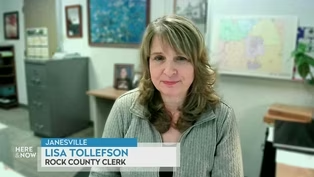
NewLisa Tollefson on Oversight of Wisconsin's 2026 Elections
Video has Closed Captions
Clip: S2500 Ep2516 | 5m 31s | Lisa Tollefson on local administration of the November 2026 election in Wisconsin. (5m 31s)
 New
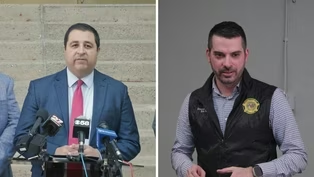
NewWhat Are the Top Issues in Wisconsin's 2026 Election for AG?
Video has Closed Captions
Clip: S2500 Ep2516 | 7m 28s | Josh Kaul and Eric Toney speak to state crime labs, abortion law and federal lawsuits. (7m 28s)
Providing Support for PBS.org
Learn Moreabout PBS online sponsorship New Episode
- News and Public Affairs

Top journalists deliver compelling original analysis of the hour's headlines.
 New Episode
- News and Public Affairs

Today's top journalists discuss Washington's current political events and public affairs.
 New Episode
 New Episode
 New Episode
 New Episode
 New Episode


 New Episode
 New Episode

Support for PBS provided by:
Here and Now is a local public television program presented by PBS Wisconsin