Here and Now
Here & Now for April 17, 2026
Season 2400 Episode 2440 | 26m 47sVideo has Closed Captions
Watch the entire episode of Here & Now for April 17.
Watch the entire episode of Here & Now for April 17.
Problems playing video? | Closed Captioning Feedback
Problems playing video? | Closed Captioning Feedback
Here and Now is a local public television program presented by PBS Wisconsin
Here and Now
Here & Now for April 17, 2026
Season 2400 Episode 2440 | 26m 47sVideo has Closed Captions
Watch the entire episode of Here & Now for April 17.
Problems playing video? | Closed Captioning Feedback
How to Watch Here and Now
Here and Now is available to stream on pbs.org and the free PBS App, available on iPhone, Apple TV, Android TV, Android smartphones, Amazon Fire TV, Amazon Fire Tablet, Roku, Samsung Smart TV, and Vizio.
Providing Support for PBS.org
Learn Moreabout PBS online sponsorshipThe following program is a PBS Wisconsin Original production.
>> April showers bring destruction as storm damage from hail, flooding and tornadoes wreaked havoc across the state this week.
I'm Frederica Freyberg.
Tonight on "Here& Now" we check in with the National Weather Service on what's been hit.
Then Senator Ron Johnson gives his position on the war in Iran and a PhD student back home in Iran provides an inside point of view of what it's like to live inside the warfare.
And groups, again, bring a legal challenge to the Enbridge oil pipeline.
It's "Here& Now" for April 17th.
>> Funding for "Here& Now" is provided by the Focus Fund for Journalism and Friends of PBS Wisconsin.
>> Governor Tony Evers this week called a state of emergency due to storms in Wisconsin.
More than 20 counties are under flood warnings and it just keeps storming.
Hardest hit Milwaukee and southeast Wisconsin and farther north toward green Bay and into central parts of the state.
Roads and highways have closed, with sandbagging underway and more sopping messes in areas hard hit last August.
How unusual is this string of wet weather and storms?
We turn to Kurt Kotenberg, a meteorologist in charge with the National Weather Service, joining us from green Bay.
And thanks a lot for being here.
>> Yeah, thank you for having us.
>> So what's been happening over the past several days in your region?
>> Yeah, it's just been one round after the other.
Pretty much everywhere across Wisconsin.
So not only the La Crosse area in southwestern Wisconsin, they issued over 55 severe weather warnings this week.
The Milwaukee area has issued over 79 severe weather warnings this week.
So it's just been statewide.
And of course, we have the terrible flooding up in east central and northeastern Wisconsin.
Long story short, so far in the month of April, so this is through the 16th of April.
This doesn't even count the severe weather happening Friday.
The the National Weather Service offices have issued 172 severe thunderstorm warnings, tornado warnings or flash flood warnings.
And to put that number in perspective, we average about 22 statewide for the entire month of April.
And that number that we've had so far halfway through April is more severe weather tornado or severe thunderstorm, tornado warning, and more flash flood warnings than we've issued in the past eight years combined.
So we are just way outside the box of anything that we typically deal with here, not only in April in Wisconsin, but almost just Wisconsin in general, even during the peak summer months.
>> Boy, those those numbers you were sharing about the number of, of weather alerts and storm warnings and stuff that is stunning.
>> It's wild.
So, so this past Tuesday, the 14th statewide, we issued 78 of those severe warnings, tornado warnings, flash flood warnings.
That's the fifth most active day in state history period for us issuing warnings.
So that includes, you know, June, July, May, like the fifth most active day happened here in the middle of April.
And then yeah, the, the flooding, especially the Wolfe River in New London, those are record highs.
So going back to 1922 was the previous record.
So in any of our lifetimes, we have not seen this type of flooding across east central Wisconsin.
And, you know, I was working with someone or talking with what the emergency managers there, and they said that the Wolfe River is so high.
There's lots of sturgeon in the Wolfe River that there's actually sturgeon in people's front yards.
And so we're going to have to coordinate with the DNR.
Once this is all done and the water starts receding, like there's going to be sturgeon that need to be netted out of people's front yards.
Like, you know, just unprecedented things in any of our lifetimes.
So yeah, just yeah, terrible, terrible flooding and terrible weather here across Wisconsin.
And again, just very, very much looking forward to this upcoming week with it stopping and being dry.
Finally.
>> With the ground already saturated, what kind of flooding could result from Friday's and storms into this evening?
>> Right.
So, you know, certainly in east central Wisconsin, you know, we're talking about the Wolfe River in particular.
You know, they've had hundreds and hundreds of people evacuating across towns such as New London and Shiocton.
So they don't need a single Moore drop or additional drop of rain.
So the Friday event is the one positive.
If there even if there is not really positive.
But the one good thing is that it's going to be a very fast moving system.
So once it's through here Friday evening, you know, it's probably going to be through Wisconsin eight, 9:00, the worst of it, you know, hopefully then it should be quiet for at least the next five days.
So that'll be a little different this moving, whereas the past couple days has been a lot slower moving.
But after that, the the kind of the light at the end of the tunnel is that we're not expecting rainfall here the next five days.
So this goes through probably until Thursday of next week.
So hopefully that'll give us a time to dry off and really start the cleanup and restoration process across Wisconsin.
>> And on the Wolf River.
Do you know what its current flood stage is or where it's at?
>> Yeah.
So it's in major flood stage.
It New London and Shiocton.
And this is record.
It's over over 19ft.
Okay, so both of those locations have set record heights.
Again, this is going back to the 1900s.
So in any of our lifetimes.
>> Do you know how many people have been evacuated from various locales?
>> As of Thursday, it was close to 2000, and I believe that it is exceeded 2000 as of Friday morning.
And again, we'll see what happens with the Friday once the Friday evening, severe weather and heavy rain is done, what that number turns to on Saturday.
>> For people like you monitoring this and putting out the warnings and seeing what's happening and seeing what's coming, how frightening is that?
>> So after the tornado by Union Center on Tuesday, the National Weather Service and La Crosse went out Wednesday morning and damaged the damage survey.
And, you know, seeing the homes and the damage, you know, these are our fellow Wisconsinites.
And, you know, just seeing, you know, some people like they've lost everything.
And so it's, it weighs on us a lot too.
And it also helps motivate us to really, you know, this is why we do this is to, to try to help help keep these people safe and protected the best that we can.
And then just seeing the impacts on the community, you know, just, just reaffirms that what we're doing is important.
And we're, we're operating 24 over seven, 365 so, you know, whatever we can do to help people stay safe weather wise is what we're doing around the clock.
>> Kurt Kotenberg out of green Bay.
Thanks so much.
>> Thank you for having us.
>> There is a new ten day ceasefire between Israel and Lebanon, and we're into week two of a ceasefire with Iran and new today, Iran announces the Strait of Hormuz is open.
The temporary détente in the war with Iran comes in the midst of a build up of U.S.
forces having steamed into the region.
Last week, we interviewed Democratic U.S.
Second District Representative Mark Pocan, who called the U.S.
Israel War with Iran.
Chaos piled on top of chaos.
Tonight, we turn to Republican U.S.
Senator Ron Johnson.
And Senator, thanks very much for being here.
>> Well, Fredricka, thanks for having me on.
>> So it seems to be welcome news that Iran has declared the Strait of Hormuz open.
But what about Representative Pocan comment that this war is chaos on top of chaos?
Are you satisfied with the war planning that went into this and the move?
>> Since last weekend?
I was on one of the Sunday morning shows and the host started the interview by saying that I was supportive of the war in Iran, and I pushed back immediately by saying, no, I am absolutely opposed to the war.
The Iranian ayatollahs declared on America 47 years ago.
The fact that they have hundreds, probably thousands of Americans, blood on their hands and obviously tens of thousands of their own citizens, blood on their hands.
So what I'm supportive of is ending that war once and for all, ending the threat, ending the menace, and ending the there any possibility that they could obtain a nuclear weapon weapon which could be existential to America.
So yeah, it is war.
Messy.
Is it chaotic?
Sure.
You know, I don't like war, but we had to act before we weren't able to act before they became a nuclear power, before they had so many missiles and so many drones that taking this action would have devastated the region.
It's been destructive enough.
But again, so I support President Trump's very difficult decision.
This is good news.
I think, you know, we have dramatically degraded Iran's capability to be a state sponsor of terror, to develop a nuclear weapon, to hold the Strait of Hormuz hostage.
And I think this latest blockade is certainly showing.
It's proving its worth in bringing Iran to the negotiating table and forcing to force them into what should be as close to, you know, unilateral disarmament and just, you know, unconditional surrender as possible.
>> And so you think it's a diplomatic course at this point, not a bombing course, to quote, finish the job, as you've said you want to do.
>> Yeah.
When President Trump met with the families of the fallen at Dover, the dignified return, he reported in his speech that the family is almost to a person said, okay, we've sacrificed now finish the job.
And I think it'd be, you know, not good if we left a regime in place, continue to be dedicated to enrich uranium, not give up those uranium stockpiles, continue to build up their missile and drone stockpiles, to continue to threaten the region and threaten world peace.
So I want to finish the job.
We have obviously decimated their leadership.
We've decimated their their missiles, their drones, their nuclear program.
But we haven't finished the job.
But we need to do that.
>> You took exception last week to the president threatening to wipe out an entire civilization in Iran.
It was a newsworthy rebuke from a high ranking Republican.
What did you think when you saw that threat?
>> I guess I wouldn't call it a rebuke.
I was asked a question.
I gave an honest answer.
We're not at war with Iranian people.
In fact, we are trying to do everything we can to support them.
We want to liberate the Iranian people, not not impoverish them.
So again, President Trump has a certain negotiating style.
I mean, I, for one, am hoping and praying it works.
I mean, Frederica, just think of how if all these things are successful, it looks like Venezuela is on the road to success.
If we can tame Iran, if we can remove that regime and get more responsible leadership in there, who are going to be more interested in governing Iran for the benefit of its people as opposed to their ideology being a state sponsor of terror?
I mean, just understand how positively that could reset global politics or the geopolitical situation throughout the world.
If Cuba could reclaim if Cubans could reclaim their liberty, their freedom.
I mean, these are, you know, Iran should be incredibly successful and prosperous nation, as should Venezuela, as should Cuba.
And it's only it's only through American leadership that those things can happen.
>> As to not being at war with the Iranian people and Iranian U.A.W.
student that is now there says it very much feels to her like the U.S.
is at war with the people.
How do you respond to that?
>> That's one person's opinion.
Again, we're not doing polls.
I mean, they've obviously canceled the internet, so we don't know exactly what's happening inside Iran.
I think one of the reasons the Iranian regime is so brutal to its people, I mean, they executed 30 to 40,000 of their own citizens in a couple of days.
Okay.
My guess is a large majority of Iranians would like to see the ayatollahs gone on the dustbin of history.
The sooner the better.
Again, I don't there are certainly people within Iran who support the mullahs and the ayatollahs, but I just have to believe when you take a look at the long history of Iran, the Persian people and stuff, I mean, this has been a prosperous land.
The ayatollahs have just devastated what could be incredibly prosperous and freedom loving type of country.
>> How, in your mind, can ordinary Iranian citizens like that U.A.W.
student of whom we spoke rise up and take over the regime?
>> Well, it's very difficult.
I pointed this out in the past.
You know, for those who just want to keep pushing nationwide gun control and those who want to disarm America, this is what it looks like when a population disarmed, when the only people that have bullets and rifles and weapons are our brutal regime, it leads to tyranny.
And we had some pretty interesting testimony in the Senate this this past week, Congressman Thomas Massie went through the list of regime after regime after regime, brutal dictatorial regimes leading to the deaths of millions of their citizens.
The first action was always disarming the population.
So it's difficult.
I think we've certainly weakened the regime.
It's as weak as it's ever been.
In his 47 years.
We may have to do some assistance.
We may have to to provide some.
I'll call it, assistance to the Iranian people so they can.
Finally, on top of that regime.
>> Senator Ron Johnson, we leave it there.
Thanks very much for joining us again.
>> Have a good day.
>> A UW-Madison School of Journalism PhD student is back home living just outside Tehran.
Each day brings fear and uncertainty for Tahereh Rahimi, who does not support the war, nor does she support the regime.
She sees her country and people living there being destroyed.
Communications are mostly down in the country, so we sent her questions to learn firsthand what it's like right now.
Here's a sampling of what she said.
>> I used to think that I am, that I was brave.
I think that's not true anymore.
About about me.
I know that it's totally fine to be scared, but I think we're really changes you depending on what type of missiles they are using, you can feel the shake.
That part is the scariest part.
If I want to describe it to you.
You know, in the spring when the lightning hits and it sounds like the sky is being ripped apart, when you lay down on the ground, you can feel it like the same, you know, ripping apart, feeling inside there.
I remember one night, the middle of the war, it was 830 or 9 p.m.
and it was raining, and we heard the sound of the fighter jets.
And it was not just one, it was a group of them just passing over our head.
And at the same time, we could hear the the explosions and also the shake.
I remember like I was thinking, why doesn't finish?
Why when, when the end is gonna come.
It is like constant torture.
You.
You are literally just waiting for something to happen to you or your loved ones.
You know you are waiting for the bomb to hit or the roof comes down or the windows to shatter.
After the jets pass over.
Obviously you feel happy that okay, I I'm safe.
My family is safe, I am safe.
But at the same time, you know that the heat they hit somewhere else, they killed other people.
You know, you feel happy at the same time that you feel guilty.
Why you are happy?
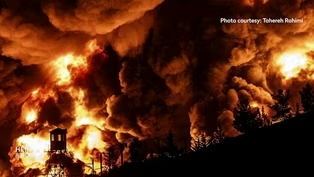
The eighth night of the attack, when Israel bombed three oil depots in Tehran and 1 in Karaj, close to where I live.
Tehran was covered under Black smoke for hours.
And then it was Black rain coming down.
It was.
It was raining Black.
You can just imagine how this can influence impact people's health, especially older people, and how it's gonna leave, you know, lasting damage and people's health and water and so on.
Us and Israeli have already destroyed my country.
More than 2000 people are killed.
I don't like just to mention numbers, but the numbers are real.
These people are blood and flesh and they are.
They are not just characters in a computer game.
More than 2000 people are killed.
Over 26,000 people are wounded.
They are literally changing my country to another Gaza where people are deeply suffering.
If they.
They have not gone already dead already.
What do you think about how this war is being covered in the media?
As you know, the internet is still down after almost 50 days.
Netanyahu was the one dragged us in this war, but I didn't see a lot of coverage.
The part that the the Israeli has done is sort of whitewashed or softened in the news media, and people just don't talk about this.
It might be the result of what I saw in how they were represented in, in domestic news media.
But it was very disappointing that like, what they were talking was just about the oil price.
Oh, the Brant oil is like now it's $0.50 higher than yesterday.
As if like it was the war was reduced to just the oil price, you know, deleting the human side of the war.
So my biggest fear is that they don't like Iranian government.
And the US don't come to an agreement.
My biggest fear is that that like somehow the ceasefire ends and they resume the war.
So it means all this nightmare is gonna happen again.
I hope that this war ends forever and never happen again.
>> The latest hearing challenging the Enbridge Line five oil and gas pipeline in northern Wisconsin unfolded late this week.
The bad River Band of Lake Superior, Chippewa and environmental groups want state permits already approved to be reversed and to halt any pipeline construction.
The circuit court judge in the case isn't expected to rule until the end of this month at the earliest, even though line five construction is being rerouted around the reservation, the band worries about damage to Upstream and Lake Superior water.
For more on this, we turn to Band River Band Chairwoman Elizabeth Arbuckle.
And thanks very much for being here.
>> Thanks for having me.
>> So fundamentally, I've had people ask why the concerns, if the pipeline has been rerouted to skirt reservation lands?
>> There's lots of reasons to be worried or concerned, and one of them is when they do the construction, they are going to be stirring up mercury deposits of from acid rain from decades past, and those have settled.
So when they come through to do that, that's going to stir up these deposits, which are then going to go directly into our waterways.
You know, they are just hugging our reservation.
It's not like they went miles and miles away.
It's literally a stone's throw from from our land reservation boundaries.
And that is going to stir up these mercury deposits that have been in our wetlands and go into our water and go into Lake Superior.
You know, we've already got we already have mercury deposit warnings and can only eat one walleye a week or a month, depending on on your age and gender.
And, and that's, that's problematic.
So if we get more mercury, that's going to affect our fishing industry.
It's certainly affecting our Ojibwe culture because like walleye, for example, is a major part of our culture.
So that's what we worry about the mercury upsets.
We also worry about the blasting they're going to do in the reroute, which is in the mountains, just off the reservation.
That's another thing that we don't know what we don't know.
They say, oh, it's safe, it's fine.
The other one is our treaty rights.
And this is key because the way they want to do the reroute is so we'll say this is the reservation.
And they're going to go like that with this being Lake Superior.
So on all three sides they're going to surround us and encircle us.
And that's problematic because they're still in our ceded territory, right?
That's still we still have rights to hunt, fish and gather in this land.
And we're not going to be able to cross into our reservation without asking their permission.
You know, that's that's not what we signed up for.
That's not the spirit of the law.
That's not been the interpretations in the and the understanding of our treaty rights.
So cutting that off, cutting us off from from our land, from our own homeland, from accessing the, the, our treaty rights that we're allowed to use, which have been upheld.
That's problematic.
>> What is your response to the DNR and Enbridge saying that environmental issues have been exhaustively researched and addressed?
>> I say I don't think so, right?
I mean, everyone like I said, everyone's been ignoring this Mercury problem.
And the problem with the heavy metals that are going to be released by the land.
So I don't think they have been exhaustively researched.
And yet there seems to be no concern about this sleeping mercury that we have in the wetlands area on and near our reservation.
>> Why the protracted fight?
>> I don't think anybody wants a protracted fight, but it's the outcome that's important, not not the battle.
So we have to protect our homeland.
We have to protect Lake Superior.
We have to protect our treaty rights.
And those that you know that that our fellow other Ojibwe bands in northern Wisconsin exercise and hold with us as well.
>> Do you feel as though you will prevail?
>> Yes.
I have to believe we will prevail in the end.
We have to.
The stakes are too high, right?
I can't, I can't imagine not.
We need to.
We need to preserve Wisconsin, Northern Wisconsin, Lake Superior.
And we're on the front lines for that.
And so we're willing to do that.
It's like I said, it's it's it's even bigger than our reservation, right?
It's even bigger than that because those waterways lead right to Lake Superior.
So it's really important we all think and study and, and look and see what they're saying and work toward, you know, stopping it.
>> All right.
Chairwoman Elizabeth Arbuckle, we leave it there.
Thank you so much for your time.
>> Thank you.
Appreciate you having me.
>> For more on this and other issues facing Wisconsin, visit our website at PBS Wisconsin.
Org and then click on the news tab.
That's our program for tonight.
I'm Frederica Freyberg.
Have a good weekend.
>> Funding for "Here& Now" is provided by the fund for is provided by the fund for Journalism and Friends of PBS Wisconsin.
In Focus with Greg Doby and Menkhu Ara Maat: Hip-Hop History
Video has Closed Captions
Clip: S2400 Ep2440 | 39m 8s | Greg Doby and Menkhu Ara Maat the legacy of hip-hop and impacts on music and culture. (39m 8s)
 New
NewBad River Band Chair Liz Arbuckle on the Line 5 Pipeline
Video has Closed Captions
Clip: S2400 Ep2440 | 5m 16s | Liz Arbuckle on asking a judge to review permits for the Enbridge Line 5 pipeline reroute. (5m 16s)
 New
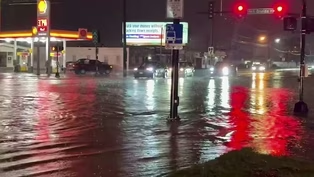
NewHere & Now opening for April 17, 2026
Video has Closed Captions
Clip: S2400 Ep2440 | 1m 3s | The introduction to the April 17, 2026 episode of Here & Now. (1m 3s)
 New
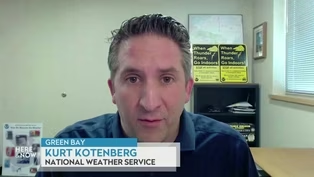
NewKurt Kotenberg on Extreme Weather Hitting Eastern Wisconsin
Video has Closed Captions
Clip: S2400 Ep2440 | 6m 48s | Kurt Kotenberg on extreme weather events seen on the eastern side of the state this week. (6m 48s)
 New
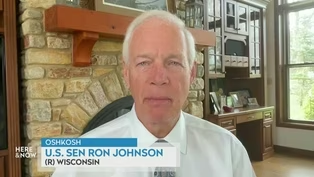
NewUS Sen. Ron Johnson on the US-Iran War and its Future
Video has Closed Captions
Clip: S2400 Ep2440 | 7m 5s | Ron Johnson discusses the ongoing war with Iran and how he sees this war ending. (7m 5s)
 New
NewWhat War is Like for a UW-Madison Student in Iran
Video has Closed Captions
Clip: S2400 Ep2440 | 5m 51s | UW-Madison PhD student Tahereh Rahimi shares her experience of living in Iran during war. (5m 51s)
Providing Support for PBS.org
Learn Moreabout PBS online sponsorship
- News and Public Affairs

Top journalists deliver compelling original analysis of the hour's headlines.

- News and Public Affairs

FRONTLINE is investigative journalism that questions, explains and changes our world.












Support for PBS provided by:
Here and Now is a local public television program presented by PBS Wisconsin