Here and Now
Bad River Band Chair Liz Arbuckle on the Line 5 Pipeline
Clip: Season 2400 Episode 2440 | 5m 16sVideo has Closed Captions
Liz Arbuckle on asking a judge to review permits for the Enbridge Line 5 pipeline reroute.
Bad River Band of Lake Superior Chippewa Chairwoman Liz Arbuckle discusses the tribe asking a judge to review a ruling that upheld permits for construction on the Enbridge Line 5 oil pipeline reroute.
Problems playing video? | Closed Captioning Feedback
Problems playing video? | Closed Captioning Feedback
Here and Now is a local public television program presented by PBS Wisconsin
Here and Now
Bad River Band Chair Liz Arbuckle on the Line 5 Pipeline
Clip: Season 2400 Episode 2440 | 5m 16sVideo has Closed Captions
Bad River Band of Lake Superior Chippewa Chairwoman Liz Arbuckle discusses the tribe asking a judge to review a ruling that upheld permits for construction on the Enbridge Line 5 oil pipeline reroute.
Problems playing video? | Closed Captioning Feedback
How to Watch Here and Now
Here and Now is available to stream on pbs.org and the free PBS App, available on iPhone, Apple TV, Android TV, Android smartphones, Amazon Fire TV, Amazon Fire Tablet, Roku, Samsung Smart TV, and Vizio.
Providing Support for PBS.org
Learn Moreabout PBS online sponsorshipnever happen again.
>> The latest hearing challenging the Enbridge Line five oil and gas pipeline in northern Wisconsin unfolded late this week.
The bad River Band of Lake Superior, Chippewa and environmental groups want state permits already approved to be reversed and to halt any pipeline construction.
The circuit court judge in the case isn't expected to rule until the end of this month at the earliest, even though line five construction is being rerouted around the reservation, the band worries about damage to Upstream and Lake Superior water.
For more on this, we turn to Band River Band Chairwoman Elizabeth Arbuckle.
And thanks very much for being here.
>> Thanks for having me.
>> So fundamentally, I've had people ask why the concerns, if the pipeline has been rerouted to skirt reservation lands?
>> There's lots of reasons to be worried or concerned, and one of them is when they do the construction, they are going to be stirring up mercury deposits of from acid rain from decades past, and those have settled.
So when they come through to do that, that's going to stir up these deposits, which are then going to go directly into our waterways.
You know, they are just hugging our reservation.
It's not like they went miles and miles away.
It's literally a stone's throw from from our land reservation boundaries.
And that is going to stir up these mercury deposits that have been in our wetlands and go into our water and go into Lake Superior.
You know, we've already got we already have mercury deposit warnings and can only eat one walleye a week or a month, depending on on your age and gender.
And, and that's, that's problematic.
So if we get more mercury, that's going to affect our fishing industry.
It's certainly affecting our Ojibwe culture because like walleye, for example, is a major part of our culture.
So that's what we worry about the mercury upsets.
We also worry about the blasting they're going to do in the reroute, which is in the mountains, just off the reservation.
That's another thing that we don't know what we don't know.
They say, oh, it's safe, it's fine.
The other one is our treaty rights.
And this is key because the way they want to do the reroute is so we'll say this is the reservation.
And they're going to go like that with this being Lake Superior.
So on all three sides they're going to surround us and encircle us.
And that's problematic because they're still in our ceded territory, right?
That's still we still have rights to hunt, fish and gather in this land.
And we're not going to be able to cross into our reservation without asking their permission.
You know, that's that's not what we signed up for.
That's not the spirit of the law.
That's not been the interpretations in the and the understanding of our treaty rights.
So cutting that off, cutting us off from from our land, from our own homeland, from accessing the, the, our treaty rights that we're allowed to use, which have been upheld.
That's problematic.
>> What is your response to the DNR and Enbridge saying that environmental issues have been exhaustively researched and addressed?
>> I say I don't think so, right?
I mean, everyone like I said, everyone's been ignoring this Mercury problem.
And the problem with the heavy metals that are going to be released by the land.
So I don't think they have been exhaustively researched.
And yet there seems to be no concern about this sleeping mercury that we have in the wetlands area on and near our reservation.
>> Why the protracted fight?
>> I don't think anybody wants a protracted fight, but it's the outcome that's important, not not the battle.
So we have to protect our homeland.
We have to protect Lake Superior.
We have to protect our treaty rights.
And those that you know that that our fellow other Ojibwe bands in northern Wisconsin exercise and hold with us as well.
>> Do you feel as though you will prevail?
>> Yes.
I have to believe we will prevail in the end.
We have to.
The stakes are too high, right?
I can't, I can't imagine not.
We need to.
We need to preserve Wisconsin, Northern Wisconsin, Lake Superior.
And we're on the front lines for that.
And so we're willing to do that.
It's like I said, it's it's it's even bigger than our reservation, right?
It's even bigger than that because those waterways lead right to Lake Superior.
So it's really important we all think and study and, and look and see what they're saying and work toward, you know, stopping it.
>> All right.
Chairwoman Elizabeth Arbuckle, we leave it there.
Thank you
In Focus with Greg Doby and Menkhu Ara Maat: Hip-Hop History
Video has Closed Captions
Clip: S2400 Ep2440 | 39m 8s | Greg Doby and Menkhu Ara Maat the legacy of hip-hop and impacts on music and culture. (39m 8s)
 New
NewHere & Now opening for April 17, 2026
Video has Closed Captions
Clip: S2400 Ep2440 | 1m 3s | The introduction to the April 17, 2026 episode of Here & Now. (1m 3s)
 New
NewKurt Kotenberg on Extreme Weather Hitting Eastern Wisconsin
Video has Closed Captions
Clip: S2400 Ep2440 | 6m 48s | Kurt Kotenberg on extreme weather events seen on the eastern side of the state this week. (6m 48s)
 New
NewUS Sen. Ron Johnson on the US-Iran War and its Future
Video has Closed Captions
Clip: S2400 Ep2440 | 7m 5s | Ron Johnson discusses the ongoing war with Iran and how he sees this war ending. (7m 5s)
 New
NewWhat War is Like for a UW-Madison Student in Iran
Video has Closed Captions
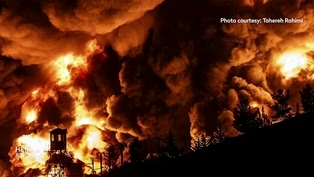
Clip: S2400 Ep2440 | 5m 51s | UW-Madison PhD student Tahereh Rahimi shares her experience of living in Iran during war. (5m 51s)
Providing Support for PBS.org
Learn Moreabout PBS online sponsorship
- News and Public Affairs

Top journalists deliver compelling original analysis of the hour's headlines.

- News and Public Affairs

FRONTLINE is investigative journalism that questions, explains and changes our world.












Support for PBS provided by:
Here and Now is a local public television program presented by PBS Wisconsin