WEDU Arts Plus
Episode 924
Season 9 Episode 24 | 26m 45sVideo has Closed Captions
Chael Blinya, Covid-19 Pandemic, Stephanie Schultz, Rob Rogalski
Chael Blinya is a Ghanaian-American rapper and writer who uses language and music to share his perspective. A community of artists in Reno, Nevada, inspire spirit and strength amidst the Covid-19 pandemic. Fashion designer Stephanie Schultz creates original garments with distinct historical elements. Rob Rogalski creates whimsical miniature movie sets, puppets and sculptures.
Problems playing video? | Closed Captioning Feedback
Problems playing video? | Closed Captioning Feedback
WEDU Arts Plus is a local public television program presented by WEDU
Major funding for WEDU Arts Plus is provided through the generosity of Charles Rosenblum, The State of Florida and Division of Arts and Culture and the National Endowment for the Arts, and the Hillsborough County Board of County Commissioners.
WEDU Arts Plus
Episode 924
Season 9 Episode 24 | 26m 45sVideo has Closed Captions
Chael Blinya is a Ghanaian-American rapper and writer who uses language and music to share his perspective. A community of artists in Reno, Nevada, inspire spirit and strength amidst the Covid-19 pandemic. Fashion designer Stephanie Schultz creates original garments with distinct historical elements. Rob Rogalski creates whimsical miniature movie sets, puppets and sculptures.
Problems playing video? | Closed Captioning Feedback
How to Watch WEDU Arts Plus
WEDU Arts Plus is available to stream on pbs.org and the free PBS App, available on iPhone, Apple TV, Android TV, Android smartphones, Amazon Fire TV, Amazon Fire Tablet, Roku, Samsung Smart TV, and Vizio.
Providing Support for PBS.org
Learn Moreabout PBS online sponsorship(upbeat music) - [Narrator] This is a production of WEDU PBS, Tampa, St. Petersburg, Sarasota.
- [Narrator] Major funding for WEDU Arts Plus is provided through The Greater Cincinnati Foundation by an arts loving donor who encourages others to support your PBS station, WEDU, and by the Pinellas Community Foundation, giving humanity a hand since 1969.
- [Dalia] In this edition of WEDU Arts Plus, a Tampa rapper appreciates the power of words.
- [Chael] I think I'm finally at a point where I can create hip hop and not worry about it not being like a stereotypical type of hip hop.
- [Dalia] Arts in the time of quarantine.
- [Courtney] It's in the silence and it's within that time to meditate that you actually become more creative.
- [Dalia] Fashion that defies definition.
- [Stephanie] I definitely wanted to build a high fashion collection inspired by the Victorian art collection here at the hotel.
- [Dalia] And crafting fantastical creatures.
- [Robert] My interest shifted away from doing two-dimensional work and working in three-dimensional work.
- It's all coming up next on WEDU Arts Plus.
(upbeat music) (upbeat music) Hello, I'm Dalia Colon and this is WEDU Arts Plus.
Ghanaian American artist, Chael Blinya, is a connoisseur of words.
He uses his talent to write and perform rap that reflects his perspective and experiences, but his love of writing goes far beyond the scope of songwriting.
(upbeat hip hop music) - [Chael] I'm not concerned with everything else while I'm doing it, it just feels very innate, but I think the biggest thing I can hope for is that they enjoy it and if they don't enjoy it, at least appreciate it because you might not like something, but you can still respect that there's like work and effort that got put into this, you know?
So I think acknowledgement maybe, but nothing more than that.
I got it, okay.
♪ Uh, this is distorted portion of Hortland ♪ ♪ Who hears the who ♪ ♪ Who hears is who ♪ ♪ Who is Dr. Seuss ♪ ♪ Simple rhymes, elementary book ♪ ♪ I do it every time ♪ ♪ I don't feel like I gotta catch the hook ♪ ♪ Yeah ♪ - [Isak] I think before me and Chael kinda got to like a certain limit where I was like, okay, I got all the, you know, all my basics, you know, I know what I'm doing and then like, when I started working with Chael, like, you know, just, I started pushing myself, he started pushing me, you know, like to keep up with the caliber of lyricism that he was already at.
- [Charles] You really see the intention and the love that he puts into his work and his performance and then getting to know him there, you, like you still see the work and how it follows through.
So there are times where Chael might be rapping to himself or repeating a line to get the cadence and the flexion just right.
He's constantly writing and rewriting and exploring different ways to approach things and that carries over to his music.
I mean, as an artist myself, I feel like I know tons and tons and tons of musicians, I know tons of artists and Chael's craft and the, the heart that he puts into his craft is definitely different from a lot of other people that I've come across.
♪ The 99 and 2004 ♪ ♪ The cash money dropping ♪ ♪ So I'm coming back ♪ - [Chael] I come from Ghanaian also, I was born in Accra Ghana in 1998 and I've been here since 2003, that's 17 years.
I came here a week before I turned five, then in 2004, we moved into our house and I've been there since.
My childhood was, it was a pretty like pedestrian childhood, you know?
I'm pretty sheltered, so a lot of my time was spent within my neighborhood, you know, my next door neighbor is now, like they're African too, so we just kind of grew up in that, that same sheltered lifestyle of this is where we are.
If we're not here, we're at school, if we're not at school, we're at church.
Performing, I would say started when I was like maybe like three, four 'cause I was that kid at that party on the dance floor from the moment the party starts to the ending of it.
So I would say I attribute my stage performance and presence to those early days, just DNA, nature of a person.
You hear music, put on a show.
My writing days probably go all the way back to like first grade, but sixth grade, I would say that's when that writing translated from more formal styles of writing to more like poetic and creative forms of writing, where I'm no longer writing in complete sentences, I'm writing and making up my own language, essentially, out of the English language and just having fun and going crazy.
I don't think the writing and performing have anything to do with each other.
I think the performing is just embedded in who I am as a person and the writing is something completely separate.
- [Charles] Watching Chael from a stranger's point of view, he can seem like a very standoffish person and then he gets on stage and he just explodes and you're like, where did this come from?
This quiet guy who is not speaking to anybody.
♪ Arm and Hammer smooth ♪ ♪ Now camera's baggy loose ♪ ♪ Pants and lateral shuffle stance ♪ ♪ Shoulder roll with that roadblock on ♪ ♪ We took a chance and danced ♪ ♪ Cause E equaled MC ♪ ♪ Previous to MC ♪ ♪ Perceived it square ♪ - [Isak] I do a bulk of the behind the scenes work, so you know, I'm mixing masters music, recording, make a lot of the, the beats, do all of the music videos.
I do all of the technical things to get everything out of his head, into the, you know, to make it tangible.
♪ It goes on and and on, man ♪ ♪ On and on like et cetera ♪ (rapping) ♪ Multiple dimension ♪ ♪ Comprehension precise ♪ ♪ Division of religion ♪ ♪ Court decision ♪ (rapping) - [Chael] Our friend Scorpio is very talented.
(laughter) He's, he's a very diverse, diversely talented individual so it makes me not want to just wake up and not give my best effort because you have somebody who's literally just like a one-stop shop for, for creative collaboration and I have a lot of ideas, but I don't have the patience to learn the technical side of it.
With Charles, I think Charles just holds me accountable and I, I'll say with Charles, he's very outspoken about how good my art is and I would be a fool to just wake up and stop making art and you have this person that's shouting your name at the top of the mountains.
- [Charles] There's definitely something incredibly special about Chael.
He has a quality to him, he has a flare to him that you won't find anywhere else.
♪ Watching PBS after school ♪ ♪ While my parents were gone ♪ - [Chael] We all know how hip hop is the trend in the media and in different outlets, so I think the fear of my parents thinking that I'm going to dive into this art form and change the way I behave as a human being is probably what allowed me to get to the root of the art form that I actually enjoy, which is the writing and the ability to bend words and get really creative.
It wasn't easy, but I think I'm finally at a point where I can create hip hop and not worry about it not being like a stereotypical type of hip hop and it just being my own brand of hip hop.
♪ Now Mr. Benjamin ♪ ♪ Tie the knot for him ♪ ♪ Lucky Thomas Jefferson ♪ ♪ Check this out, my wallet says ♪ ♪ Misfortune lingers inside of all them crevices ♪ ♪ Crinkle cotton fibers of them Hamilton ♪ - [Charles] It's a work in progress, but it's a movement that won't be stopped.
- [Chael] The art keeps me centered, it keeps me grounded, it keeps me focused.
It just doesn't allow my mind to wander and stay idle.
It allows me to have purpose in everything I do, just because I know at the end of it, the art will probably help somebody else.
- [Dalia] For more information, visit facebook.com/novicefromthemiddleofaugust.
Even amidst the COVID-19 pandemic, the spirit and strength of many arts communities did not diminish.
We head to Reno, Nevada to see how artists continue to create and inspire in these difficult times.
(uplifting music) - [Emily] I am a professional artist and I am quarantining at home and my home is full of paintings because the art shows I had scheduled were canceled.
- [Erica] There's something so valuable about having the live space, the face-to-face interaction, the kinesthetic empathy, that's really important and I really miss all of these places in Reno, like Echo Enzo and the Loft and Flux Movement Lab where we can dance together and create together and I think people really need that and miss that.
- [Courtney] It's in the silence and it's within that time to meditate that you actually become more creative, so I've had a lot more ideas over the past two months, I've written a lot more and my passion to actually create something has definitely grown over the short amount of time that we've been forced to be alone.
- [Beth] Art is really a historic trail of, of the stories that are going to be told about this time.
I mean, art comes out of situations like this, of tragedies and, and hard times and I believe that the arts will tell a story of what is happening right now for people in the future.
- [Megan] I have seen lots of artists respond to this in different ways.
I have seen artists hold raffles, or sell art to fundraise for relief funds and give back to those in need in the community.
I think through sharing their art, artists are helping connect and uplift.
For example, the Drakulich Foundation for Freedom of Expression has turned from making paper out of old military uniforms and they've hired veterans to make masks, some from those recycled military uniforms.
- We have produced over 1700 masks so far and are excited to say that many of those have been donated to underserved communities.
We also make orders for businesses to help them get back to work.
It's really special to take the military uniforms and use them to protect citizens and this is what they look like and they're very handsome and well-made.
As you can see, they're easy, they're comfortable, they're light.
You can tie them as tight as you want, or hang them like so for errands and then they just slip right down over your ears and you can go about your business until you need it again and it is wonderful for veterans and myself to remain engaged and productive during this difficult time of social distancing and helps us to keep our art resources alive and well, so they're ready when we can get back to making art as a community again.
- COVIDANCE 19 is a way for dancers to create something in their own home with a roommate, a pet, you don't even have to be a dancer, just movement and then create something, send it in via a smartphone, and release one dance every 19 days and of course, the quarantines lasted longer, they do every 14 days, but it was just really awesome to see what people came up with.
People were dancing with inanimate objects, Tweety bird had a moment, there, there were contact improv partners, there was dancing with themselves, or walls, or floors, and it was just in light, it was just really lovely to see what people came up with and how they tied, oftentimes what they were dancing with or too, with what they were going through and how they were dealing with the quarantine and everything that's going on right now, which is highly volatile and extremely changing and inconsistent and there's a lot of gray area.
None of us really know what's going on.
- [Bryce] During this time, quarantine, I've just really been, I guess, more creative, I think, working on new projects.
Me and my family, we had the opportunity to go up the road to Melton Elementary School and paint a mural for all the kids in school.
A lot of the kids probably haven't seen it yet, but hopefully it's a something that really brightens their day and gives them a smile when we're finally able to go back to school.
- [Emily] Okay so, since some of my art shows were canceled, I've decided to sell my artwork online in an auction format and all of that money is going to local charities.
Something else that I've done since we've been quarantined is make a coloring book about the quarantine using animal puns and a color your own postcard set and these whales say, whale, it looks like we'll be together for awhile, that was one of the puns.
- [Courtney] I think something that I've really learned during this period of time is how capable I am, you know?
Film is something that takes an army to create and I think that when you're forced to create something on your own, or you want to create something and you only have your roommate there, you become more creative in how you're going to go about making that happen.
So I think that it's definitely been encouraging for myself to be like, oh look, you actually know how to do all of these elements and you can do them pretty well and, and that shouldn't restrict you in the future to create something if you've only got one or two people.
- [Megan] Art is the connector, whether it connects people to each other, or makes us feel less alone when we see something, or read something, or listen to something that speaks to us, it's an expression of the human experience, an interpretation of the world around us.
We need that connection now.
Public art has always served this purpose and it's still accessible during this time.
Unlike galleries and museums, which are closed, there's still access to our public spaces, so the public art collection is available to anyone at any time.
It serves to create a sense of place and community to connect, inspire, and transform.
- [Courtney] This quarantine period and this period of isolation has definitely shown people the importance of art because we are now forced to get down to the core of who we are because we're alone with ourselves.
- It brings out the creative side.
When you're stuck in home, it's something you can do.
You can always pull out pencils and pens and markers and paint and create something and so, it just gives you an outlet to always be able to create.
- But you need art in every form.
People express themselves through dance, through drawing and making pictures and telling stories and art is the one thing that is going to bring us all together.
- [Megan] We are resilient and creative, all of us, and it's been super inspiring and wonderful to see how people are figuring out new ways to connect often through art.
The arts will be a large part of rebuilding and finding our new normal as we move forward.
- [Dalia] For more about the arts in Reno, visit arttown.org.
Milwaukee, Wisconsin, fashion designer, Stephanie Schultz, is creating original garments in the gallery space at the Pfister Hotel with unique designs that incorporate historical elements.
(subtle music) - [Stephanie] Fashion is the armor that every single person wears.
It's a way to externalize who you are inside.
My name is Stephanie Schultz and I am a fashion designer.
To me, fashion design is more than just making clothes.
It's about also telling a narrative and telling a story with what I'm making, at least I feel like that's my responsibility as a fashion designer, especially being a couturier and working in, in more of high fashion.
They're a bit tight, but they look so good.
The difference between ready to wear and couture, or high fashion, it's more about like, when do you want to use it?
When do you want to wear it?
And everybody's personal style is different.
So for me, what I wear as my casual, maybe somebody's like way out there, super fancy outfit.
I think I have a distinctly unique look about my work, especially if you're looking at my work compared to other Milwaukee designers.
I'm, I'm the only one who does like historically influenced high fashion and I've never really felt like I personally fit into any kind of subculture completely.
Like, I don't completely fit into goth subculture.
I don't completely fit into Japanese street fashion culture.
I don't completely fit into steam punk.
I'm an amalgamation of all of these things and so is my work.
Part of what my responsibility is as a designer is showcasing that beauty comes in a lot of different forms.
I've always been a person who's a little bit outside the box.
That's why couture is great because it allows me to be rebellious, but with my fashion.
Couture doesn't have to follow any kind of rules, which is really exciting.
The hardest part of being a designer is when you are designing something first and then figuring out, okay, what's the geometry of the shape that's happening here?
How do I make that into a 3D piece?
So when I'm designing, I like to create pieces that do have lacing in the back, or a little bit of stretch, or cut on the bias so that they conform to the body a little bit better because I like to, to make sure that the piece that somebody is getting from me is going to last them for a really long time.
When I'm making things that are really feminine, I use a lot of ruffles and I use a lot of flouncy kinds of fabrics and I use a lot of really nice, high-end textiles and things that are very delicate.
I definitely wanted to build a high fashion collection inspired by the Victorian art collection here at the hotel.
The Pfister has the largest collection of Victorian art anywhere in the country.
It gives me a place to start, but it's not that I'm making exact replicas of what's in the paintings, it's me interpreting what's there into something that's high fashion and into something that's modern with that historic element to it.
There were some interesting elements in all of these paintings that I really wanted to draw inspiration from and translate into fabric and have, have a living painting and do my interpretation of them where you get the general idea of, well, you look at them and you say, oh yeah, it's that painting, definitely.
People are so far removed from the making process of things.
People will be able to see the actual process of how a thing is made and I'm hoping that it'll give them a greater appreciation for clothing, whether or not it's ready to wear.
Fashion is more than clothing, fashion is art.
(upbeat music) - [Dalia] Learn more about Schultz's work at silversark.com.
Rob Rogalski is an artist in Rochester, New York whose whimsical art enraptures those who visit his studio.
His miniature movie sets, puppets, and sculptures, transport you to a fantasy world.
(subtle music) (machine buzzing) - [Robert] My name is Robert Rogalski.
I'm a local artist here in Rochester, New York.
The work I do is whimsical and fanciful.
I have a love of puppetry and all things geeky.
People are always asking me, well what medium do you work in?
And I work in multiple mediums, I'm a sculptor, I do illustration.
My background was of course, I wanted to get into visual effects when I was younger.
I was desperate to work for a creature shop for Hollywood, so that involved learning all these different disciplines, such as illustration, design, sculpting, model making, all these kinds of things.
So it's kind of one of those, those processes where you become someone who wears many hats.
I have two areas that I focus in on the most right now, which is doing illustration work and that's usually my bread and butter, kind of a lot of fun doing, post your work and, and things along those lines, but then the other one is of course, sculpture.
(upbeat music) My teacher asked me what I wanted to be when I grew up, I said, oh, I want to be a book illustrator and then my interest shifted away from doing two-dimensional work and working in three-dimensional work.
Sometimes I don't have a clue what I'm going to do, other times I have a vague idea and then there are the moments where yes, you know exactly what you want to do, what you want to create, but you often find out that, especially if you're working with found objects like I do, that the objects will dictate what you're going to make.
(upbeat music) It's a very organic process.
You pick something up and then you look at it in different angles and you could suddenly see, well wait a second, this should be a part of a headset for a character, or this should be a piston, or maybe this will be a part of a laser rifle idle.
There have been times too, when I started working on a project and midway through I'm like, oh, this is going to be horrible, this isn't working and then suddenly I'm done with it and I look at it and I'm like, oh, I love this.
This is, this turned out better than I thought it would.
I started out with wanting to get into animation and then it turned into, wait a second, I can actually build these things that will be real creatures right there.
I love practical effects.
I still love puppets and sculptures and miniature landscapes and models and all that kind of stuff and that's why I kind of became obsessed with making it.
You know, I could probably focus in on figure sculpture and other kinds of things, but this is a lot more fun.
- [Dalia] To see more of his work, check out robertrogalski.com.
And that wraps it up for this edition of WEDU Arts Plus.
For more arts and culture, visit wedu.org/artsplus.
Until next time, I'm Dalia Colon, thanks for watching.
(intense music) (intense music) (intense music) - [Narrator] Major funding for WEDU Arts Plus is provided through The Greater Cincinnati Foundation by an arts loving donor who encourages others to support your PBS station, WEDU, and by the Pinellas Community Foundation, giving humanity a hand since 1969.
(uplifting music)
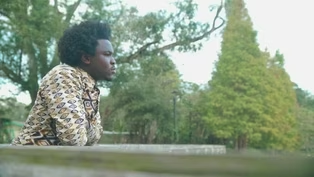
Video has Closed Captions
Clip: S9 Ep24 | 6m 35s | Tampa resident Chael Blinya, Ghanaian-American rapper and writer. (6m 35s)
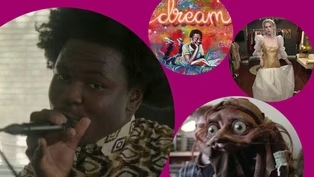
Preview: S9 Ep24 | 29s | Chael Blinya, Covid-19 Pandemic, Stephanie Schultz, Rob Rogalski (29s)
Providing Support for PBS.org
Learn Moreabout PBS online sponsorship












Support for PBS provided by:
WEDU Arts Plus is a local public television program presented by WEDU
Major funding for WEDU Arts Plus is provided through the generosity of Charles Rosenblum, The State of Florida and Division of Arts and Culture and the National Endowment for the Arts, and the Hillsborough County Board of County Commissioners.