WEDU Arts Plus
1505 | Episode
Season 15 Episode 5 | 26m 46sVideo has Closed Captions
Ybor's Tempus Projects | Icy Landscapes | Wildfire Impacts | Reimagining City Life
Explore bold, contemporary art across the U.S. Tempus Projects in Ybor City builds creative community through exhibitions and residencies. Artist Zaria Forman captures fragile icy landscapes in striking pastels. A California exhibit probes wildfire impacts, while a Norfolk mural project reimagines city life through students’ eyes.
Problems playing video? | Closed Captioning Feedback
Problems playing video? | Closed Captioning Feedback
WEDU Arts Plus is a local public television program presented by WEDU
Major funding for WEDU Arts Plus is provided through the generosity of Charles Rosenblum, The State of Florida and Division of Arts and Culture and the National Endowment for the Arts, and the Hillsborough County Board of County Commissioners.
WEDU Arts Plus
1505 | Episode
Season 15 Episode 5 | 26m 46sVideo has Closed Captions
Explore bold, contemporary art across the U.S. Tempus Projects in Ybor City builds creative community through exhibitions and residencies. Artist Zaria Forman captures fragile icy landscapes in striking pastels. A California exhibit probes wildfire impacts, while a Norfolk mural project reimagines city life through students’ eyes.
Problems playing video? | Closed Captioning Feedback
How to Watch WEDU Arts Plus
WEDU Arts Plus is available to stream on pbs.org and the free PBS App, available on iPhone, Apple TV, Android TV, Android smartphones, Amazon Fire TV, Amazon Fire Tablet, Roku, Samsung Smart TV, LG TV, and Vizio.
Providing Support for PBS.org
Learn Moreabout PBS online sponsorship- This is a production of WEDU PBS, Tampa, St.
Petersburg, Sarasota.
[music] - Funding for WEDU Arts Plus is provided by Charles Rosenblum.
Hillsborough County Board of County Commissioners, the State of Florida, and Division of Arts and Culture, and the National Endowment for the Arts.
In this edition of WEDU Arts Plus: a local catalyst that's making Ybor City an arts destination.
- The rising tide lifts all boats, right?
And so I would say that Tempest Projects is really at the head of that flotilla in terms of bringing people together, bringing other organizations and partnerships together and really serving as a catalyst.
- Pastel drawings of changing landscapes every year.
- Growing up as a child, we would travel to these remote places for at least a month at a time, and that's what instilled in me a love of landscape.
- An impactful, interdisciplinary exhibition.
- Forest fire, in its essence, is a conversation starter for a very complicated and troubling topic for the community.
- And a mural that highlights local cuisine.
- I proposed this project that I'd been working on in southeast London, which is called "Gormandizing", and it's about collecting recipes from the different neighborhoods in south London.
- It's all coming up next on WEDU Arts Plus.
[music] Hello, I'm Dalia Colon and this is WEDU Arts Plus.
It has been said that a rising tide lifts all boats when it comes to the arts in Ybor City, Tempest Projects leads the flotilla, supporting artists through residencies, collaborations, exhibitions and special events.
[music] - Tempus Projects has a pretty multifaceted approach to what we do here in Tampa.
We function primarily as an exhibition space, but we also have a very busy schedule of an artist-in-residence program.
We also host workshops with those artists in residence and also just visiting artists.
[music] My name is Tracy Medulla and I am the founder and director of Tempus Projects.
[music] We like to show emerging artists, along with early career artists and mid-career artists and established artists in their careers.
And what that has done for the last 17 years is it's given artists of different places in their career the opportunity to show together, which sometimes acts as a way to elevate what some of the emerging artists are doing, and it also brings a freshness to the approach that some of the more mid-career or established artists do.
Having a place like Tempest gives us all a place to show work and congregate and collaborate with one another.
I feel like it helps to fortify and build a real foundation for what we have here.
The Ybor Arts tour is one day that we do twice a year, where we put together a tour of galleries and artist studios throughout Ybor City.
We work collaboratively with usually between 10 or 12 other stops.
It gets everybody out and sharing and seeing what everyone else is doing.
It's a wonderful opportunity for cross-pollination, and that makes me feel incredibly proud to be part of that network.
[music] - I think Tempest Projects is really vital to the Tampa Bay arts community.
They really provide a platform to support emerging and established artists.
They really create an impact in that it becomes sort of a cultural nexus.
It's a place where people can go, whether they're an arts enthusiast, whether they're an artist, Tempest present, like really cutting edge work that is being produced here locally by artists here in Tampa, but also from the artists in residence, always pushing the boundaries, looking for new partnerships, and elevating the level of collaboration that occurs not only in the visual arts, but between all the interdisciplinary arts in the area.
[music] - We currently have two exhibitions up in Tempest Projects.
One of them is titled, "Nothing to See Here," and it is a group of seven artists.
The exhibition deals with topics like secret rituals, work that goes quiet or unnoticed at times.
- I have been showing with Tempest Projects for a little over a decade, almost as long as I've been in Tampa, and it's been a huge driver in terms of my career and my practice.
It's something that's been really important to me.
I've been in a variety of group shows and individual exhibitions here, so it's something that's really helped me sustain a studio practice.
[music] - The other exhibition that we have is a two-person show featuring the work from Lisa McCarthy and Wallace Wilson.
The title of that exhibition is, "Awkward Transactions."
[music] This particular exhibition is a collection of works that either Wallace Wilson made independently and Lisa McCarthy reacted to, or that Lisa McCarthy made.
And Wally has a response to.
- It's been an excellent collaboration with Tempest Projects for both Lisa and myself.
You know, I think Tracy's responsible for a lot of the direction of the work that we've completed here.
- He and I collaborated on this work, but she collaborates with the community and we feel good about our work because she's such a dynamo in the community.
So it's a win-win, win-win.
[music] - In the Tampa Bay arts community.
We always talk about the rising tide lifts all boats, right?
And so I would say that Tempest Projects is really at the head of that flotilla in terms of bringing people together, bringing other organizations and partnerships together and really serving as a catalyst.
- Being successful at this job is being happy at this job and having the opportunity to work with exciting people and feeling like I'm giving back to the community in a positive and exciting way.
[music] - She's an innovator.
Uh, she's smart, she's open, and really wants to make a difference in the art community.
- And it's highly, highly respected in the community for giving newcomers a chance and also honoring, you know, geyser types like us.
[music] - To learn more, visit tempest-projects.com.
With her large scale pastel drawings New York-based artist Zaria Forman documents the destructive effects of climate change.
Find out how her visits to remote regions such as Antarctica and Greenland have inspired her work.
[music] - I grew up with an artist mom, and she was in love with the most far off remote landscapes she could possibly find and venture to.
And so every year, growing up as a child, we would travel to these remote places for at least a month at a time.
And that's what instilled in me a love of landscape.
So my mom and I were planning a trip to go to Greenland in 2011 together, but my mom was diagnosed with brain cancer and passed away before we could take the trip together.
I thought that was the end of my traveling days.
I didn't think I had it in me to plan those kinds of expeditions that she did.
I decided to do it in her honor.
I was spreading her ashes along the trip in several places.
That was also the first time I drew ice.
I hadn't drawn ice before that trip.
Greenland is epic.
The sun is at a much lower angle, and so the icebergs would just be lit up in this most dramatic way.
And this fog would hover over the horizon.
Especially my iceberg drawings.
I see them as portraits.
By the time I'm finished with a drawing of an iceberg, it's likely completely melted or looks completely different.
[music] Undertaking that trip, I think, is what gave me the confidence to continue.
[music] Standing next to a glacier, you feel so tiny and coming back from these places and wanting to represent them as best as I can, and trying to give the viewer that experience of what it's like to stand next to a glacier or an iceberg.
The only way I feel like I could come as close as possible to that is by drawing as big as I possibly can.
So when I travel, I take thousands of photographs on site, and I try to soak up the landscape visually and not always having the camera right in front of my face.
And then I get back to the studio, and I work from both my memory of the experience, as well as the photographs to make these large scale compositions.
[music] As I'm drawing, I'm recalling the experience I had in that moment, you know, on the Zodiac, looking at the iceberg and remembering what the light looked like and how that experience felt.
So I tried to imbue the composition with as much of my memory as I can.
I want it to look as realistic as possible.
And so.
So that's what I use the photograph for an up close.
It does become very abstract, and just looking at the line and form and shape and color, I've just always had an obsession with charcoal and soft pastel.
Just something about the material.
I love the simplicity of just making a mark on the paper, and that's what it is.
And I can move the pigment around and I can change the way it looks.
There's no other factor other than just me and the material.
[music] I just got an email one day that was like, the most exciting email I've ever received.
That was, you know, someone saying, hey, um, would you like to come fly with us?
Love NASA.
[laughter] Not exactly like that, but in so many words, that's like it was a very brief email and it was like, here's my number.
Call me.
Do you want to come fly with us over Antarctica in the spring?
I thought it was a hoax.
Literally up until the day I landed and met the science team.
And we had our first science meeting and I was like, okay, this is NASA.
It's extremely grueling work, especially the Antarctica flights.
They're like on average 10 to 12 hours long every single day.
It's like you're flying across the planet day after day after day.
It's some of the most important work that's happening in the world now, because there's so much we don't know about how ice moves and melts.
I've been traveling to icy landscapes for a long time now.
And so I, you know, I felt like I had a, a fairly deep understanding just visually of ice, but this was like a whole new ball game and a whole new perspective.
[music] And seeing it from that perspective really made me realize not only the scale of ice, but the scale of the global climate crisis that we're in the middle of.
I mean, it's just it's so much ice.
You can really see how like, yeah, if that's melting at the rapid pace that it's melting at our global sea levels will rise and there's a lot of horrible consequences.
[music] This is Jakobshavn Glacier in Greenland.
It dispenses the most amount of icebergs into the ocean as of any other glacier in the Arctic.
We flew over it for hours and hours.
I took the photo from the plane.
So it's an aerial view, but in between those ridges is probably about 150 feet.
There's a whole batch of new colors in this piece, some that are really bright and luminous.
[music] And it's also just personal for me because the fjord where this iceberg dispenses ice directly into is where I spread my mom's ashes.
[music] I feel like she's a part of that landscape.
[music] I'm trying to portray the beauty in these places that are at the forefront of climate change, and just give a moment in time and people's life to contemplate it, because it's not always a part of our everyday life.
I want people to understand it.
I want people to be moved by it and have an emotional reaction to it, and fall in love with the ice as I have.
When you love something, you want to protect it.
It'll make them think, well, what can I do to help protect and preserve these landscapes that are changing so quickly?
[music] - For more information, head to zariaforman.com.
Forest fire is a multisensory, interdisciplinary exhibition that examines forest fires, presenting the work of California writers and artists.
The installation raises awareness and inspires a conversation about the growing issue.
[music] - Forest fire, in its essence, is a conversation starter for a very complicated and troubling topic for the community, and we've broken it up into three very distinct public engagement platforms.
One is a very comprehensive interpretive exhibit which tells the story of the of the forest ecology and its involvement with humans.
[music] We wanted to engage the community further by being involved with the local school district.
So with Sierra Watershed Education Partnerships, we we created a collaborative relationship with them who have created curriculum for the Truckee Tahoe Unified School District to teach forest ecology.
[music] - Forest fire as a project, demanded this sense of multiple partners coming together with different things to offer.
Nevada County Arts Council played a key facilitating role, along with the Sagehen Creek Field Station and Llewellyn Studios, in bringing together multiple partners including California Arts Council, California Humanities, Nevada Museum of Art in Reno, the University of Nevada, Reno.
The list goes on.
The support has been amazing.
[music] The exhibition is located at the Truckee Donner Recreation and Park District's new community recreation center.
It's one of the most public spaces in Truckee.
[music] - We've worked with 17 artists, four of the artists we have loaned work from, and the other 13 artists we commissioned directly to create pieces for the exhibit because the topics are so unique.
There was no previously existing artwork for them.
[music] - If you think about the whole Forest Management challenge, it's really complicated and we all learn differently, so we need to have different ways to tell a story.
- We said, hey, you know, there's a problem in the forest.
We're having catastrophic fire.
But there is a solution.
- By the different media.
The variety of media that were used here in this exhibit.
It allows people to find what they might resonate to and hopefully allow them to find something that they can connect with.
- There is 2D art and 3D art.
We have paintings, we have sculpture, we have textile work.
[music] - We wanted to bring the forest inside.
So when people walked into the exhibit, they knew immediately that there is an exhibit about a forest.
[music] Since this is a public space where it's not a place where people are going to see art, it's a place where people are coming to do other things.
They're going to pass through this.
So we wanted people to understand the issues, whether they spent 30 seconds, 30 minutes, three hours, three days in the exhibit.
[music] We wanted it to be a visceral experience.
So when people walk into the exhibit, the first thing they see is the forest overhead.
So they immediately get a feel for, whoa, this is a forest.
And the forest itself is a timeline of the forest ecology, of the chapters of the of the story.
[music] You walk into the old growth forest, and then you get to what happened to the old growth forest.
And then you get to the forest that we have now.
And then you get to the hopeful future Forest.
So as people walk through this corridor, they get the entire story in one artwork.
Hopefully that makes them stop and go, what the heck is going on here?
And leads to a more engaged experience.
[music] - Although this is a California based project, in many ways it's not.
Here we are on the edges of California and Nevada.
Certainly the Washoe people, the earliest peoples here, would have had no concept of state lines and county lines.
We're in the northern central Sierra and forest fire relates to swathes of forest in all directions.
[music] - This forest was managed for thousands of years by the people who were here before us and the tool that they had, the washo had was fire.
You know, in the fall, when they leave, they would light the place on fire.
We have science to support that.
We have cored tree stumps and we can get a history of pre-European, small intensity fire, short time interval every couple of years.
We need to get the process back that these systems evolve with.
[music] - The key message is one that fire need not be our foe.
It can be our friend and that if we work with fire and with the elements and working across sectors, we can create a sustainable forest system which will survive catastrophic fire.
We're living in an extraordinary time.
I think we'll all agree that science has never been less respected as it is today.
One of the things that artists bring to the voice of the scientist is an emotional perception, something that will trigger an emotional response, that will enable a deeper understanding that we need in order for science to make headway and improvements and bring solutions.
[music] - For more information, go to forestandfire.org.
Designer and artist Matthew McGuinness teamed up with students from the Governor's School for the Arts in Norfolk, Virginia.
Together, they create a mural that explores what lunchtime means in the city.
[music] - I reached out to Norfolk.
Last year, I proposed this project that I'd been working on in southeast London, which is called Gormandizing, and it's about collecting recipes from the different neighborhoods in south London in the wake of all the change and regeneration that's going on.
I thought it would be an interesting project to capture the taste of the town.
[music] - Rachel McCall from DNC reached out to me to ask if we'd be interested in creating a mural with Matt McInnis, who is an artist based in London.
I said, I would love to do a mural.
I can make a class out of this and I want to teach it.
- The question remained, how do you make a mural from south London to Norfolk?
- We zoomed.
If there's one good thing that came out of the pandemic, and that is that we could work with an artist based in London.
So we started in the spring.
- It requires a great deal of research and investigation.
[music] - Our students had to come up with different ideas about food and what lunchtime in Norfolk means to them.
[music] - We were each given a different innovation wave about a specific time period of food.
- We would find a recipe and see if it sparked any creativity.
And then we went out to a library into their historical books to find like, cookbooks.
- I did find out at the time there was a Duke of Norfolk, and he apparently had a royal punch that he always had prepared for him, which was made of local fruits that were known to grow in the area.
So I just was excited to paint that.
- We actually interviewed people working at their local businesses and kind of telling us the culture, how they make their food and how it all ties together.
- One of our students found a recipe in a church cookbook and it was a recipe for happiness.
So that's why you'll see the word happiness down at the bottom.
And it was really an underlying theme of the whole food bringing people together.
What does food mean in a community?
There's this whole broad representation of different cultures, different time frames, and it's really meant to celebrate food and the community.
[music] - I didn't know how lucky I'd be to be working with Governor's School.
I'm genuine when I say that these students are extraordinarily talented.
- I'm meeting Matt was just super amazing to actually meet somebody who's actually made it in the industry.
And that's just really wow, like that could be me one day.
[music] - The color palette was really hard to come up with.
We were given different ideas and we collectively voted as a class over which color palette we liked the most.
Lots of neon blues and greens, which turned out really nice.
[music] - My wife is from here.
I got married at the Chrysler Museum.
We spent a lot of time here in the neon area before I think it was coined the neon area, and I thought if we ever came back here, this would be where I'd want to be.
I'd love to come back here and do something there.
Just seemed like there was a lot of potential.
And now here I am.
So, you know, 13 years of windy roads at every turn.
I'm just amazed at how dedicated the administration are.
These people are passionately developing these young minds.
And and it's evident to see the output, right, the student work and how focused they are.
[music] - It was really crazy to see it all done.
We spent weeks out here working on this and now people get to like admire it.
It was really gratifying.
[music] It's refreshing.
I think that people get to see what I'm capable of doing.
I'm glad people get to see my art.
It'll continue to be seen on the wall for years to come.
[music] You can go back and like, I did that.
[music] It's a really nice.
[music] - To see more of his work, go to matthewmcguinness.com.
And that wraps it up for this episode of WEDU Arts Plus.
To view more, visit wedu.org/artsplus or follow us on social.
I'm Dalia Colon.
Thanks for watching.
Video has Closed Captions
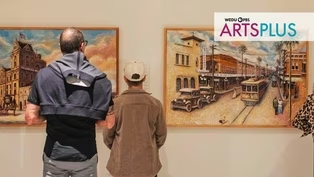
Clip: S15 Ep5 | 5m 55s | In Ybor City, Tempus Projects connects artists and community through creative work. (5m 55s)
Providing Support for PBS.org
Learn Moreabout PBS online sponsorship

- Arts and Music

Innovative musicians from every genre perform live in the longest-running music series.










Support for PBS provided by:
WEDU Arts Plus is a local public television program presented by WEDU
Major funding for WEDU Arts Plus is provided through the generosity of Charles Rosenblum, The State of Florida and Division of Arts and Culture and the National Endowment for the Arts, and the Hillsborough County Board of County Commissioners.