WEDU Arts Plus
1413 | Episode
Season 14 Episode 13 | 26m 33sVideo has Closed Captions
Elvis & The Citrus County Courthouse | Uzbekistan Folklore | Images of the Night Sky | Canine Art
Visit the Old Courthouse Heritage Museum in Citrus County, made famous by Elvis Presley’s 1961 film "Follow That Dream". Meet a self-taught illustrator from Uzbekistan whose work draws on the folklore of her childhood, discover photographer Grant Kaye’s breathtaking images of the night sky, and explore the American Kennel Club Museum of the Dog and its unique collection of canine-inspired art.
Problems playing video? | Closed Captioning Feedback
Problems playing video? | Closed Captioning Feedback
WEDU Arts Plus is a local public television program presented by WEDU
Major funding for WEDU Arts Plus is provided through the generosity of Charles Rosenblum, The State of Florida and Division of Arts and Culture and the National Endowment for the Arts, and the Hillsborough County Board of County Commissioners.
WEDU Arts Plus
1413 | Episode
Season 14 Episode 13 | 26m 33sVideo has Closed Captions
Visit the Old Courthouse Heritage Museum in Citrus County, made famous by Elvis Presley’s 1961 film "Follow That Dream". Meet a self-taught illustrator from Uzbekistan whose work draws on the folklore of her childhood, discover photographer Grant Kaye’s breathtaking images of the night sky, and explore the American Kennel Club Museum of the Dog and its unique collection of canine-inspired art.
Problems playing video? | Closed Captioning Feedback
How to Watch WEDU Arts Plus
WEDU Arts Plus is available to stream on pbs.org and the free PBS App, available on iPhone, Apple TV, Android TV, Android smartphones, Amazon Fire TV, Amazon Fire Tablet, Roku, Samsung Smart TV, and Vizio.
Providing Support for PBS.org
Learn Moreabout PBS online sponsorshipThis is a production of WEDU PBS Tampa, St.
Petersburg, Sarasota.
[music] Funding for WEDU Arts Plus is provided by Charles Rosenblum, Hillsborough County Board of County Commissioners, the State of Florida, and Division of Arts and Culture, and the National Endowment for the Arts.
In this edition of WEDU Arts Plus, it's been a courthouse, a movie set, and now it's a museum.
This building was really the center of the community's life here in not only in Inverness, but in Citrus County.
A folklore illustrator.
I grew up in a culture that had lots of those mixed cultures.
Uzbekistan is the place where I was born.
It's like a crossroad of so many different cultures.
Photographing the night sky.
I like to create a variety of images just to keep things fresh and interesting.
My heart is always going to be, you know, solidly in capturing the landscapes of the American West and international locations.
And a museum dedicated to dogs.
Recently hosted an exhibition of Dogs of War and Peace.
We have a lot of images of dogs that how they helped on the battlefield and off the battlefield, as well as therapy dogs.
It's all coming up next on WEDU Arts Plus.
[music] Hello, I'm Dalia Colon, and this is WEDU Arts Plus.
The old Courthouse Heritage Museum in Inverness has quite a storied past.
Once the center of life for Citrus County residents, the building gained worldwide attention when an A-list celebrity filmed a movie there.
Today, the museum honors its history while offering exhibitions and events that keep it as relevant as ever.
Inverness is located 90 miles north of Tampa on the west coast of Florida.
I love the small town feel.
[music] We are thankfully very underdeveloped.
We're on the nature coast and there's a lot of nature here, and it's just a beautiful area to come and see for a lot of different reasons.
It's got about 7800 people, and maybe on the outskirts there might be 10,000.
But the whole key here is that it's been around for 125 years.
This building was actually the original courthouse of the town.
The building is now a history museum.
This building was really the center of the community's life here in not only in Inverness, but in Citrus County.
And it was also the county seat.
You had the school board, the sheriff on different county entities.
The clerk based here in this building.
There's all kinds of history of the town baked right into this building.
[music] In the archives we have the repository of every deed from the beginning of this county's birth 1887, up through the 1980s, at which point they became digital.
We'll have some people that will come in and ask, is my house haunted?
And we'll say, yes, you should run very quickly...no.
[music] And they would show movies here.
It was the biggest space that was available here in Citrus County.
So they would have performers here.
People would come in at night when they weren't meeting with the county commissioners.
They would have performances.
And we kind of honor that tradition here by having concerts here and lectures every so often.
We're very community oriented.
It's not just a hands off the artifacts, but we encourage people to come in here and really feel the the atmosphere and the ambiance of the courtroom.
I love how people react when they come in this building.
It has a vibe, and one of the things that we like to point out is that there are indentures in the marble stairs going up, so you can see that people traipsed up those steps for over a hundred years.
We are partnering with Florida Humanities and Smithsonian on a local food history exhibit, and the title name will be Florida Foodways A Taste Through Time.
This is an exhibit that's a collaboration with our community, with items that have been donated and loaned to us to show the history of food in our community.
We've done all kinds of research on what the earliest peoples of Florida were foraging and hunting 14,000 years ago, all the way to different cultures that are more modern to our area and what the local cuisine is in different areas around Central Florida specifically.
One of my personal favorite items in the local history gallery is our orange sorter.
Children and adults love to come and see what it was like to sort oranges back in the day.
[music] I like to think of the museum as a cultural center.
Personally, I'm an artist.
I do painting and drawing and that type of thing, and I actually teach a lot of craft classes for children.
We actually have adult craft and art classes as well.
We've got an annual tribute to Elvis, and we actually have two Elvis concerts this year.
Well.
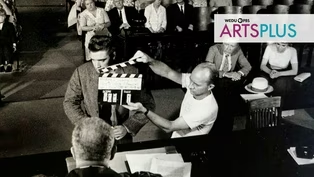
[music] Back in 1961, we had Elvis come in and he did a movie, " Follow That Dream."
Follow that car!
It's headed for this theater loaded with the most happy go lucky group of wanderers who ever came down the pike.
Chasing after a rainbow and the happy go lucky of them all.
Is the one and only Elvis himself.
I've gotta follow that dream.
Wherever that dream may lead.
In the movie, they wanted to have a courthouse to film courtroom scenes because Elvis character gets into some trouble with the law, and they needed it to be somewhere near a beach as well, because there were beach scenes in the movie.
I've interviewed people that were here when Elvis came to town.
They actually remember interacting with him.
He threw the football with a bunch of kids who would be, you know, older now.
And he did karate chopping outside the courthouse as well of pieces of wood to impress the lady folk.
I suppose.
It was the biggest thing that happened in town.
There was local investment of some of the local governments into the movie, and it helped just let people know that this town was here.
[music] After the movie ended, you know, we're on the map.
And the powers that be said, let's modernize.
So they modernize the building downstairs and upstairs.
And the building used to look like this, and we switched it over.
[music] And instead of having it being demolished, they ended up saving the building.
And we decided to refurbish it.
Resurrected to make it a heritage museum.
This building is very important to keep because it tells the whole history of our county right in one place.
Now the problem was, was the blueprints and the floor plans were gone, so they had to come up with a way to put this room together when they wanted to restore it.
And the Elvis movie stills is what we did, the way he was shot from the back.
Oh, you know, we'll do the the bench and the railing.
The way he was shot from the front.
Oh, you know, we got the two half moon offices we need to recreate.
And it helped us because if it wasn't for Elvis, we wouldn't have been able to put this back the way it is today.
Thank you Elvis, thank you very much.
[music] To learn more about the Old Courthouse Heritage Museum, visit cccourthouse.org.
Head to Ohio to meet Dinara Mirtalipova.
She's a self-taught illustrator and designer from Uzbekistan.
Passed down generation to generation.
Uzbek and Russian folklore shape her work, with the stories of her youth being a source of inspiration.
[music] I call it folk art because folk art means art of the people.
[applause] [music] Dinara Mirtalipova paints from her heart.
She draws influence from what's familiar, whether it's old scary fairy tales or the flowered patterns her grandmother wore.
I grew up in a culture that had lots of those mixed cultures.
Uzbekistan is the place where I was born.
It's like a crossroad of so many different cultures.
Um, it has like a very interesting history, all the way from Genghis Khan to being under the Soviet influence for such a long period of time.
[music] Living in the US as an adult, Mirtalipova turned to art, from sketching to painting.
[music] So I work mostly in gouache, and gouache is a water based paint.
My scale is very small.
And with gouache, it's possible to get those tiny details with the tiny brush.
But sometimes when I paint larger, I go with acrylics, because acrylics is more like water resistant and it stays longer.
[music] For years, she's been sharing her art online, initially through blogging and more recently through Instagram.
Her online posts have led to all sorts of collaborations.
So I've been mostly sharing my work and my personal work.
And to my surprise, um, I started receiving some requests to illustrate a book to like everything.
Like from little projects like stationery to wallpapers and murals.
For her latest children's book, due out in 2023, woven of the world, she's illustrating familiar Uzbek customs, such as how her grandmother wore clothes with multiple patterns.
Everything mismatched, and it was totally okay by her.
Like she liked to just wear things that are colorful and she didn't really care.
Like if this color goes well with this color.
And I kind of find that cute now.
[music] In woven of the world, she's illustrating the craft of weaving through a variety of cultural traditions.
So it's not just about weaving as the craft, it's about how we're all, like, woven one culture into another.
Mirtalipova is also currently working on a book project with her own young daughter, writing the poems.
So it's a book about the North Pole Village, like what is happening in the North Pole.
It involves characters like Mr.
Claus, Polar Bear and his little helpers, mice, who do all the charming work of wrapping up gifts and preparing and creating and painting toys.
[music] Mirtalipova says making art is like yoga for her fingers, providing relaxation and a way to separate from the stresses of life.
Self-taught in her practice, she encourages others to create, too.
[music] If the process brings you peace and you enjoy it, you call yourself artist and anyone can become one.
So art should make you feel happy or like I would say like provoke reaction, like.
Sometimes the reaction may be that you have to wake up and realize what's going on in the world, but sometimes it has just to bring you peace.
And I guess it just depends on the person.
What is it that you are seeking in life?
What is it that's missing?
And if you find art that somehow communicates that, that's awesome.
[music] For more go to mirdinara.com.
When taking a photograph, Grant Kaye looks to the night sky as the landscape astrophotographer.
He captures remarkable landforms and the celestial objects that appear above them.
Head to Truckee, California for the story.
[music] Typical day in the field for me would be packing up my truck and picking a destination and getting off the highway as soon as possible, and out onto a dirt 4x4 road and bouncing down the road until I find a great place to camp.
And, and then, uh, you know, putting my camera gear in a bag and going for a walk until I see, you know, something that inspires me, something that is meaningful geologically and, uh, you know, just trying to get there in time to wait for the sun and the clouds to light up and the sunset to happen and the light to pop and things to get interesting.
[music] My name is Grant Kaye and I live in Truckee, California.
I'm a landscape photographer, a time lapse photographer, and a landscape astrophotographer, meaning that I shoot the landscape under the night sky.
[music] I've been a photographer pretty much my whole life.
I grew up in a house with a darkroom that my dad built.
He was a professional photographer in Hawaii in the 1970s.
I like to create a variety of images just to keep things fresh and interesting.
My heart is always going to be, you know, solidly in capturing the landscapes of the American West and international locations.
I really like to be out in active landscapes, finding places around the world that have interesting geologic phenomenon erupting volcanoes, glaciers in Alaska and Iceland.
[music] Before I was a professional photographer, I had a career in volcano hazard management.
Specifically, I worked for the United States Geological Survey and the New Zealand Institute of Geological and Nuclear Sciences.
I used to study the potential risks from various volcanic eruption scenarios.
As a geologist, you're really in tune to nature and trying to unravel the riddles and the mysteries of why landscapes look the way they do.
And as a visual artist, I'm always looking for interesting elements of the landscape that would make for a beautiful and compelling photograph.
[music] I feel like my whole 20 year career as a scientist is really useful when I'm trying to, you know, examine and plan for shots in various places around the world.
[music] The kinds of photography that I'm most comfortable doing are where I'm pushing the limits of the gear that I have, you know, extending exposures out into the 20 or 30 second range, trying to pick up faint starlight and, you know, galactic light from the Milky Way galaxy.
It's an art of utilizing technology to showcase nature.
For example, uh, an eclipse sequence.
You know, where I'm stacking 22 frames of a lunar eclipse over six hours, with one frame taken every ten minutes.
[music] So the art is almost showcasing a little bit of the science that's used to create the art.
A lot of astrophotography is planning and figuring out you know, where and when the moon and sun are going to be, and when the Milky Way might come up throughout different months at each landscape.
I also do a lot of motion control, time lapse photography, motion control.
Time lapse is where you use robotic motors to move your camera during the 4 or 6 hours you're shooting a time lapse, and it has a really beautiful effect of showing parallax in your in your shots, where you might have one element of the landscape moving past another element of the landscape because the camera is moving through the shot.
[music] I like to do a lot of photography of the night sky stars.
One of my favorite things to shoot is the Milky Way galaxy over dark landscapes.
[music] The Earth is rotating every 24 hours, and if you point your camera at the North Star or Polaris, that's the point in the Northern Hemisphere that's fixed where the Earth's axis rotates around.
So if you're pointing your camera at Polaris, then all the other stars in long exposures are going to trail.
[music] The place we live is perfect for the type of art that I like to create.
There are, you know, immeasurable, gorgeous landscapes of every variety, every ecological zone.
You could hope for mountains, desert, lakes.
[music] There's also not a lot of people in this part of the world, which means there's not a lot of light pollution, skies are dark.
It's pretty easy to drive an hour or two from Truckee, where I live and have completely black skies.
Black Rock desert is a great example of some of the darkest places in North America.
So if you really want to see, you know, the light of our Milky Way galaxy, the way Native Americans saw it 10,000 years ago, then you can just go out into the Black Rock desert and spend a night out there and look out into the night sky and very little light pollution.
You can have that same experience.
[music] In addition to being a photographer, I'm also an educator.
I teach classes at Sierra College, at Atelier in downtown Truckee, at the Martis Camp Club, and I teach out shooting the west in Winnemucca, Nevada.
[music] My favorite thing about teaching is when students have that aha moment when something clicks, and then I can see that they've taken that leap and they're applying what they've learned, and they see they're on the back of their camera screen, something that they never thought they could do before.
And it just there's nothing better than that feeling when class is over.
And I know that people are going to go out and their photography is going to improve.
People have a connection with the landscape that they may not realize, and there's so much out there.
There's so many interesting characters and back roads and small towns and saloons and beautiful landscapes, and I seek those places out in order to create art that I can share with people, to spark their curiosity so that they might embark on their own journey and, you know, go out there and sort of see how amazing it is.
[music] To see more of Kaye's work, go to grantkaye.com.
The American Kennel Club Museum of the dog features a wide assortment of canine related artwork.
Founded in 1982 and located in New York City, the museum highlights the meaningful role dogs play in society and the strong bond they share with human beings.
[music] The one thing you have to realize when you come here is the fact that it's an art museum first and foremost, this is a collection, possibly one of the greatest collections of dog art in the world.
[music] It comprises about 1700 objects, primarily fine art work, other paintings, drawings, sculptures, ceramics, a whole variety of things, all dedicated to the dog.
[music] We've had several exhibitions.
We have a robust schedule.
Some that come to mind are the women in Dogs in the Arts.
We found that in going through the collection, how many women were involved in really good dog artists?
And we want to show that off.
[music] We've had Hollywood dogs.
We have a number of posters.
[music] We have presidential dogs, and we do that every four years.
Talk about the different pets and dogs that different presidents owned.
[music] Recently we've hosted an exhibition of Dogs of War and Peace.
We have a lot of images of dogs that how they helped on the battlefield and off the battlefield, as well as therapy dogs and helping people come back.
Particularly poignant was The Wounded Warrior Dogs by James Mellick, an Ohio artist who crafted these allegories of dogs and reflecting the injuries, the suffering that not only the handlers but also the dogs incurred.
[music] One of the great joys of bringing this museum to New York was the reception we've had for the library.
The library is always packed.
We have an activity center.
[music] We have about 4000 volumes of the AKC library.
We not only have a great collection, but we also have state of the art, digitally interactive displays.
You can train a virtual dog.
I think I just heard her, Molly.
We took a ten year old lab out in Los Angeles, put on a motion capture suit and then filmed her there.
So all the motions and reactions are in real time, the way the dog would have done it.
Probably the most popular is to find your match.
Not the dog you should have, but the dog you look like.
It takes your photograph and through AI decides what dog you look like.
[music] We have a meet the breeds table where you can learn about all 200 breeds in the AKC.
[music] The oldest work here is a 30 million year old fossil of a hesperocyon, which was an early dog.
Most of our paintings start around 1670s, and then go on to today and show a variety of different activities that dogs engage in.
[music] [applause] Queen Victoria was probably the most important person in the 19th century and elevating the status of the dog, rather than just being a working dog in the field to be a dog in the home.
[music] and became very popular to have dogs as pets.
I think the crowd favorite here is Silent Sorrow.
A very sad painting.
It's, um, shows Caesar Edward, the seventh dog.
After the king had passed away, Edward the Seventh inherited his mother, Queen Victoria's love of dogs.
Edward the Seventh stipulated that Caesar was in his funeral procession ahead of nine heads of state.
It was important to him.
He was painted by Maud Earl, and it shows his dog Caesar, leaning his head on his master's armchair as the armchair slowly fades into the background and obscurity.
[music] Another work we have here, which is probably one of the greatest American dog paintings, is Sensation in Bang Bang.
It's painted by John Martin Tracy.
It's a magnificent painting out in the woods.
This is by far his best work.
The light filtering through the trees, the atmosphere that he brings to it.
It's just a stunning work.
There were two pointers that were imported by the Westminster Kennel Club back in the 19th century.
One of them, sensation, is the dog that eventually became the logo for the Westminster Kennel Club, which you see at the at their show all the time.
Another popular piece is not a painting, but it's, um, actually Queen.
Queen is a carousel dog by the Loof Factory, probably around 1890s.
It shows a mastiff.
[music] It hit me after looking at a lot of dog paintings throughout my life.
I'm starting to look at dogs differently.
[music] And I would see things I didn't see in the dog that the painter was telling me.
And it really all of a sudden was like a moment where I said, this is really the goal of art.
Whether it be a dog painting or conceptual work or abstract work, is to make you see the world differently through the artist's eyes.
And that's what you learn.
You learn about dogs and you say, I never really noticed that.
That's an interesting thing.
[music] For more information, visit museumofthedog.org.
And that wraps it up for this episode of WEDU Arts Plus.
To view more, visit wedu.org/artsplus, or follow us on social.
I'm Dalia Colon.
Thanks for watching.
[music]
Video has Closed Captions
Clip: S14 Ep13 | 6m 48s | The Old Courthouse Museum in Citrus County boasts historic charm and a storied past with Elvis. (6m 48s)
Providing Support for PBS.org
Learn Moreabout PBS online sponsorship













Support for PBS provided by:
WEDU Arts Plus is a local public television program presented by WEDU
Major funding for WEDU Arts Plus is provided through the generosity of Charles Rosenblum, The State of Florida and Division of Arts and Culture and the National Endowment for the Arts, and the Hillsborough County Board of County Commissioners.