WEDU Arts Plus
1411 | Episode
Season 14 Episode 11 | 26m 56sVideo has Closed Captions
When the Righteous Triumph | Native American culture | Public murals | Collaborative portraiture
Playwright Mark E. Lieb explores Tampa’s 1960 civil rights protests in "When the Righteous Triumph". An exhibition in Reno features artist Jean LaMarr’s multimedia reflections on Native American culture. Salem’s Punto Urban Art Museum showcases over 70 public murals. Ohio photographer Amber N. Ford is known for creating powerful, collaborative portraiture.
Problems playing video? | Closed Captioning Feedback
Problems playing video? | Closed Captioning Feedback
WEDU Arts Plus is a local public television program presented by WEDU
Major funding for WEDU Arts Plus is provided through the generosity of Charles Rosenblum, The State of Florida and Division of Arts and Culture and the National Endowment for the Arts, and the Hillsborough County Board of County Commissioners.
WEDU Arts Plus
1411 | Episode
Season 14 Episode 11 | 26m 56sVideo has Closed Captions
Playwright Mark E. Lieb explores Tampa’s 1960 civil rights protests in "When the Righteous Triumph". An exhibition in Reno features artist Jean LaMarr’s multimedia reflections on Native American culture. Salem’s Punto Urban Art Museum showcases over 70 public murals. Ohio photographer Amber N. Ford is known for creating powerful, collaborative portraiture.
Problems playing video? | Closed Captioning Feedback
How to Watch WEDU Arts Plus
WEDU Arts Plus is available to stream on pbs.org and the free PBS App, available on iPhone, Apple TV, Android TV, Android smartphones, Amazon Fire TV, Amazon Fire Tablet, Roku, Samsung Smart TV, and Vizio.
Providing Support for PBS.org
Learn Moreabout PBS online sponsorshipThis is a production of WEDU PBS, Tampa, St.
Petersburg, Sarasota.
[music] In this edition of WEDU Arts Plus, a local play explores a little known chapter of the 1960 Civil Rights movement in Tampa.
To see our story play out on a stage is exhilarating.
It's rewarding.
It makes you know that what you did was not in vain.
Depicting Native American life.
She wants audiences and everybody who sees her art to know that Native American cultures are a living and vibrant culture.
An open air museum.
The word deferred to me had a double meaning.
It held some of the weight of the financial kind of burden that we're kind of experiencing now in this country.
And an artist trajectory.
I love photography because it can be both a documentation of what's already around us.
It's all coming up next on WEDU Arts Plus.
[music] Hello, I'm Dalia Colon, and this is WEDU Arts Plus.
Playwright Mark E. Leib grew up in Tampa, but like many people, he had never heard of the 1960 Civil Rights protests that happened locally.
Fascinated by the history, he wrote the play, When the Righteous Triumph, to explore the story of black high school students who staged peaceful protests that eventually led to the desegregation of the city.
[music] I've been writing plays since the late 1970s, and I wanted to write about social justice, but I didn't know what precisely I would write about.
I found Andrew T. Hughes's book, from Saloons to Steakhouses A History of Tampa, and he had a chapter there called, "A Place At The Table," and was all about the 1960s sit-in demonstrations that desegregated downtown Tampa lunch counters.
I thought, I grew up in Tampa.
I was a child in Tampa when these took place.
I didn't know they happened, and I don't think anybody that I know was aware that they had happened.
This struck me as a perfect subject for a play.
[music] I don't have to serve anyone.
I don't want to.
At this counter, that means colored like you either stand or get nothing.
To see our story play out on a stage is exhilarating.
It's rewarding.
It makes you know that what you did was not in vain.
I'd like the Coca-Cola, please.
I'll fight, that started at those lunch counters was because we wanted the dignity and the respect accorded everybody else in America.
We knew where we could go, where we could not go, where segregation locked the doors in our faces.
And if we were able to enter some private establishments, for example, we were not treated the same as other patrons.
You could buy food, hot dogs, hamburgers, what have you.
But everything you bought was to go, and then you left the store after you made the purchase.
You couldn't sit down and eat in the store.
That was at a time when a leader was right in the middle of us, and that was Clarence Fort.
[music] We got just as much reason to demonstrate as anyone in Carolina.
The sit-ins started in North Carolina at F.W.
Woolworth.
On February 1st, 1960.
I went and talked with the president of our council and told him, say, we have the same problem here in Tampa, so why don't we do the same thing here in Tampa?
You hear what's happening in Greensboro?
Well, that's what's coming.
So y'all better get used to it.
Tampa is not Greensboro.
It was the NAACP Youth Council.
Young people led by Clarence, who was the new president that convinced the older leaders, including Reverend Lowery, that this was something that they were going to go forward with.
What I'm asking is for bodies to go to some lunch counters in downtown Tampa and simply sit there and order a soda or a coffee.
Now, they're not gonna serve you.
They're gonna tell you to leave, and they're gonna threaten to call the police.
Clarence went to Middleton High School and talked to the president of the student government, the late George Edgecombe.
And he went to Sheriff Scott, who was the president of the student body at Blake High School.
And he said, I need 20 students from each school to go with me.
We're going to sit-in lunch counters and demand to be served.
And I was one of the ones that George selected.
He told me, he said, you're the last one.
Because the world would know.
Before we got there, we had told you first.
[music] Ms.
Sardinia is a powerhouse, and I love how vocal she still is about what happened and how this show is giving her an opportunity for her voice to be heard about what happened so far back then.
I told Clarence here I couldn't put the NAACP on that course.
My name is Clay Christopher, and I play Reverend Alan Lowry.
Not only do I wear a lot of his actual clothes on stage, but I have a wealth of knowledge that came from Ms.
Shirley Lowry, Reverend Lowry's widow.
So much influenced how I step into the role.
I'd say that I'm now more determined than ever to fight for what I believe to be right.
He became one of the peacemakers, very instrumental in helping the mayor, you know, bring about some kind of agreement between the parties.
We have succeeded.
And the reverend got us there.
When the lunch counter was integrated, man we was overjoyed...man.
You all have waited for this a long time and have every right to celebrate.
I'm just happy that the place shares what the 40 of us felt and stood for in 1960.
It's about all of us who fought the good fight then, and dared to stand up against the system that was perpetuating all of this injustice against us.
I think we'll try something different.
Coming from Tampa and remembering the bad old days when Jim Crow was everywhere.
I wanted to work through that myself and finally deal with something that had bothered me when I was ten years old, but that I hadn't understood in the least.
And as I was writing it over the months that I wrote it, I was feeling a personal satisfaction that finally coming to grips with my hometown and my childhood.
Congratulations.
What I think that folks in general can take away from when the righteous triumphed, someone paved the way.
Someone did it.
Here's the story that happened right in your town.
And it wasn't that long ago.
The other thing that I want us to take is a cautionary tale.
If we are not careful, we will repeat.
It's going to take everybody, everybody on the same team to make progress continue to happen.
There's still so much more to do.
So I'm not going to be daunted by the task.
I am going to continue the fight as long as there's breath in my body.
and I want these young people to know and understand and to be inspired to stand up and fight for what is right, good and just.
[applause] [music] Catch the premiere of Triumph, a documentary based on this story, on Thursday, December 4th at 9 p.m.
or visit wedu.org/triumph.
Born in Susanville, California.
Community artist and activist Jean Lamar uses printmaking, painting, video and more to represent Native American life and culture and address important issues affecting indigenous people.
Visit Reno, Nevada to see an exhibition of her work.
[Native American singing] I hope when someone sees my work, they feel joy and feel the colors and how exciting the indigenous life is.
And the designs and these were all created by my ancestors, and they were experts in these fields.
She has been committed to rejecting the idea of the vanished American Indian.
She wants audiences and everybody who sees her art, to know that Native American cultures are a living and vibrant culture.
There's nothing about us.
In the fourth grade, I never learned about California Indians, and I said, where are all the Indians?
Because just me and my sisters were going to school and we were the ones that were getting beat up on.
When Gene went away to college at UC Berkeley, she was told by her professors that she couldn't include cultural content in her artwork.
She couldn't paint things that had native relevance or cultural relevance, or it would be considered folk art.
Gene has always rejected those types of ideas, and she's been committed to forging her own path.
I went to Berkeley and there was a class of over 500.
Peter Selz was an art historian talking, and he made a comment about an artist's work in.
One student in the class said, I object to that.
I don't think you're right about that.
I think it should be this way and this way and this way.
Right away I felt like, oh man, that guy, he's going to be a lot of trouble.
He'd get kicked out of class, but Peter Selz welcomed that and thanked him for his input and said, yes, that did add to that.
So I finally realized I have a voice because, you know, we're the product of boarding school parents and students and we're told not to talk, say, dance, do anything whatsoever.
Well, finally we get to be recognized.
We finally get to be recognized.
And we're proud of who we are.
We know our own history, and nobody can put us away because we had a lot of brave people because they were so brave, were able to be alive now.
[Native American singing] [music] Murals are so important because they're like a community statement, especially if you can go out and get the oral histories and learn some of the early histories and what really happened to the community.
You can put that image in that community and know non-Indian can come in there and say, no, that's all wrong.
I worked on a mural in the gymnasium on the Susanville Indian Rancheria with a community.
The Susanville Indian Rancheria is where we all live.
Most Indian home places are called reservations, but in California they called it rancheria.
So this is the beginning of life.
So we heard about the coyote stories, and here's, Mr.
Coyote sneaking around, going looking for food.
We showed sagebrush and the baskets that are made from here.
It comes around here to an era that was ancient from hundreds of years ago.
They had layers and layers of baskets and moccasins.
Then it goes all the way over.
Goes to the times when Lawson was here, and then to the bear dance.
That had been a real long tradition.
Then old man Joaquin is in the middle.
Then it comes to the contemporary times.
We're still alive.
We're still celebrating our heritage and our culture.
[music] This mural is done in Susanville, California, on Lassen Street.
Our ancestors, our future.
So I interviewed all these different people in town because I know they had ancestors here from a long time ago.
We got a lot of good comments.
People walking by.
Oh, this is really nice.
The Indian people, I see them standing by their relatives, all the little kids standing in front of their relatives, and they take a picture of it.
It's just really nice.
It's really nice.
That's what I like to see.
I respect the fact that males do need to be changed.
They can't stay forever.
It's not a Michelangelo where they have to keep repairing it.
So it reflects kind of like the times.
If we do murals that says we're present here and now, that means we're still alive.
[music] In the early 1990s, Jean returned to her hometown of Susanville, where she established the Native American Graphic Workshop.
The Graphic Workshop is a unique community hub where she brings together youth from the community, elders as well as different artists.
It's fun for people to do.
It's a kind of an introduction to printmaking, working with the oils, solvents, paper, how to handle press, how to handle the paper.
I got people that do so fantastic work, but they don't even realize what they're doing.
They're doing something beautiful.
If I could do it, they can do it.
I hope I can lock down lockdown barriers.
[music] See, I like how the transparency looks.
It's not too heavy.
It's softer than you could bring up some hard lines with it.
Definite imagery.
[music] All of us here have either learned from her, worked with her, been inspired by her work, continue to be inspired by the work tonight, or asked for Jamie and Toby Stump to come up and sing a song for Jane.
[music] The Nevada museum of Art is really proud and honored to be able to present this retrospective exhibition of Jean Lamar's work.
It features over 50 years of her paintings, prints, murals, installations.
I'm so grateful for Anne to giving me this opportunity.
No other museum would give me this opportunity.
I'm a community artist, political artist, so it's difficult to get into a place.
[music] As you're looking at Jean's artwork.
You'll see a variety of symbols and motifs appear from time to time.
Sometimes that's a military fighter jet flying overhead.
Sometimes it's sort of this ubiquitous barbed wire that you see throughout the American West.
Sometimes it's an American dollar sign, and she uses all of these symbols in different ways to critique American culture and to critique what has been a dominant culture that's for a long time suppressed Native American cultures in the United States.
[music] Everyone has a hope.
Everything has hope.
Happiness in there.
It might look negative, but there is hope for every little thing.
Or I'm making fun of something.
I would never hurt anybody's feelings on purpose.
That's not not my personality because we're really kind hearted people.
Being positive, being positive on all notes that there's there's a way out.
There's there's hope.
There's always hope.
I always have to have hope.
[music] Learn more at nevadaart.org.
At the Punto Urban Art Museum, art is presented outdoors, located in the El Punto neighborhood in Salem, Massachusetts.
The public is able to appreciate over 70 large scale murals by international and local artists.
In the Salem neighborhood, known as El Punto, or The Point.
These residential buildings double as towering gallery walls featuring portraits, landscapes and dreams.
These beautiful murals are the backdrop to this community.
Yenny Hernandez is one of the many artists who have contributed to the some 75 murals that populate this small neighborhood.
Her work is featured on this sprawling wall, which turns over annually.
This year's theme, interpretations of the American Dream.
For Hernandez, as poet Langston Hughes wrote, it's a dream deferred.
The word deferred to me had a double meaning.
It held some of the weight of the financial kind of burden that we're kind of experiencing now in this country.
To illustrate that, I created a glitch effect to represent the misalignment that exists between the dream and how we arrived to that dream.
It's a sentiment that makes this and the myriad other murals nestled in the neighborhood for and of the community formerly known as the Punto Urban Art Museum.
They are emblazoned on buildings owned by the North Shore Community Development Coalition, a nonprofit serving this low income community with affordable housing, health services and now art.
Mickey Northcutt and David Vallecillo are the museum's co-founders.
What art does is that it it's kind of like destructors, the complexity of the topic of bringing two communities together.
So we think of art as the vehicle to talk about complex issues like segregation, racism, and actually portrayed different points of view.
For years, the densely populated working class neighborhood has seemed a world away from tourist heavy downtown Salem, even though the point is just a few blocks away.
Northcutt blames an enduring stigma.
For some, it's racism.
For some, it's xenophobia.
I think a lot of it is the criminalization of poverty in this country that people feel that somehow poverty is a choice or a crime.
Enter art as the change agent.
What began as one crosswalk punctuated with portraits has become a cherished maze of murals.
We thought, could we do something that would be beautiful and inspirational for people who are living in the neighborhood, to really just change the narrative of anything to do with negativity?
The people behind these murals are a combination of Salem residents and artists from diverse backgrounds who take time to learn about the community before making their mark on it.
We started with a crosswalk.
Then we did one mural and we see how people will interact with the artists with the art.
And little by little, we start asking the community if they liked it or not.
And then this is where we're here today.
One of the most recent muralists is Salem artist Anna Dugan, who collaborated with Yenny Hernandez on a vibrant mural that stretches around this city block.
We knew it was going to be colorful, but something that was, you know, celebratory of the Latinx population that lives in the point.
Something that pays homage to the businesses below the mural in the front.
The Si Se Puede is a manifestation of optimism and perseverance, which I think is part of the DNA of the Latin experience.
Perseverance is a motivating factor for keeping the point on point.
All across the United States, mural meccas have become hip tourist destinations.
Miami's Wynwood district was among the first, but once a Warren of warehouses, it's now been fully gentrified.
That won't happen in the point, says Mickey Northcutt.
Here, nearly all of the walls that have been done are on properties that are permanently deed restricted as affordable.
None of them are on residential buildings that are designed to drive the price of those buildings up, which so often is the case in other communities.
They're really engineering gentrification.
Although the point has become a tourist destination now, even with a must see designation and go to travel guide Lonely Planet.
But that's allowing North Shore CDC to bake the arts into future projects, including, and quite unconventionally, indoor gallery space.
It's a boon for artists to Anna Dugan decided last year to become a full time muralist.
Everyone talks about Salem and talks about the witches and like, you know, all that stuff, but they don't realize what kind of beautiful art lives here.
And hopefully inspires here.
Yenny Hernandez also grew up in low income housing, but without the art infusion, she can only imagine the difference that would have made.
Had I seen work like this it probably would have had me thinking more, questioning more, um, maybe putting myself out there more, but because there really wasn't any art programs, I didn't know what to do with my artistic abilities.
I didn't know what outlets existed.
And so I found that much later in life.
And I think that's the power of public art.
And so I'm really happy to be a part of that for hopefully the next generation.
[music] Plan your visit at puntourbanartmuseum.org.
Ohio artist and freelance photographer Amber and Ford's art can be seen on both a national and local scale.
Well known for her portraiture, she connects and collaborates with her subject to create a meaningful image.
I love photography because it can be both a documentation of what's already around us, or you can get very creative and fantastical and create scenes.
I tried other art mediums like painting and drawing and ceramics and things like that, and photography is what I liked, loved the most.
And I was the best in.
And it was what made the most sense for me when it came to figuring out something that would be a career, but also still fun.
I get commissioned to take photographs for other people, but also I take photographs for myself as well.
And getting hired as a freelancer for places like The New York Times, The Washington Post, most recent Vox Media.
I really enjoy that because every assignment is different.
I get to meet new people, go to new places.
Shooting for publications can be difficult because you never know what you're going to walk into, but that also can be the exciting thing.
I never know really what the subject looks like a lot of the times.
Sometimes I'll try to look them up and yeah, maybe I can find them on LinkedIn to just get an idea.
But a lot of times like, yeah, I'm walking in and just like, hey, let's do the thing.
Also, I've been able over the last couple years to work with some of the larger organizations in Cleveland institutions.
I just never imagined as a student that now six years after undergrad, that I would be working with some of the people and some of the institutions that I'm working with now, which is, um, really exciting and really interesting.
[music] I'm interested, as I continue to develop within my artistic practice, to to be more considered as a contemporary artist or conceptual artist than just a photographer, because I want to be able to choose whatever medium makes the most sense for the concept and idea that I have versus trying to make photography always fit.
Like, yes, I can do a lot with photography, but sometimes other mediums do make more sense, and I want to give myself the the time and the space for that experimentation to figure out what works the best.
Like right now for my residency at Moca Cleveland, um, my end goal is to have an installation that has both objects and audio versus having a photography exhibition.
Moca has provided a studio space for me to create work, but also a classroom space for me to do as whatever I please.
So what I've decided is to create this kind of prompt within the classroom so that people can read a little bit of my thinking and what I'm interested in and want to talk about, and there are prompted questions for people to participate in if they choose to.
I think that grief unites us because it's something that whether we want to go through or not, we all, we all go through it, right?
We all experience it in some type of degree.
And in that thought, we can also potentially help each other within that process as well.
And I want to encourage people to not just celebrate people when they're gone, but also think about how can we celebrate ourselves and each other while we're still here.
It just really makes me happy that the entire wall is almost filled.
That just solidifies the fact that people did need this, and I was happy to use this space and opportunity to facilitate that for other people.
Work can come in many different shapes or forms, you know?
Um, and as an artist, I just want to continue to grow and, and make things that are relevant, um, to me and the time and the people and the community that's around me.
[music] Find out more at ambernford.com.
And that wraps it up for this episode of WEDU Arts Plus.
To view more, visit wedu.org/artsplus Or follow us on social.
I'm Dalia Colon.
[music]
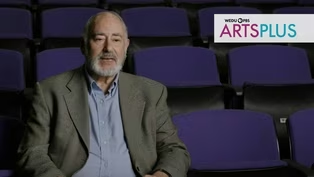
1411 | When the Righteous Triumph
Video has Closed Captions
Clip: S14 Ep11 | 6m 48s | Mark E. Lieb presents a compelling stage portrayal of Tampa’s impact on the Civil Rights Movement. (6m 48s)
Providing Support for PBS.org
Learn Moreabout PBS online sponsorship













Support for PBS provided by:
WEDU Arts Plus is a local public television program presented by WEDU
Major funding for WEDU Arts Plus is provided through the generosity of Charles Rosenblum, The State of Florida and Division of Arts and Culture and the National Endowment for the Arts, and the Hillsborough County Board of County Commissioners.