
Here and Now
Jim Drees on a Program to Reduce Homelessness in La Crosse
Clip: Season 2500 Episode 2513 | 6m 39sVideo has Closed Captions
Jim Drees on La Crosse's goal of achieving a "functional zero" homeless population.
La Crosse County Pathways Home homeless response system manager Jim Drees describes lessons learned from a program with the goal of achieving a "functional zero" homeless population in the community.
Problems playing video? | Closed Captioning Feedback
Problems playing video? | Closed Captioning Feedback
Here and Now is a local public television program presented by PBS Wisconsin
Here and Now
Jim Drees on a Program to Reduce Homelessness in La Crosse
Clip: Season 2500 Episode 2513 | 6m 39sVideo has Closed Captions
La Crosse County Pathways Home homeless response system manager Jim Drees describes lessons learned from a program with the goal of achieving a "functional zero" homeless population in the community.
Problems playing video? | Closed Captioning Feedback
Where to Watch Here and Now
Here and Now is available to stream on pbs.org and the PBS app.
Providing Support for PBS.org
Learn Moreabout PBS online sponsorshiphere.
>> Two years ago, we checked in with the mayor of La Crosse, who was painfully confronting surging numbers of people experiencing homelessness and living in encampments.
In response to the problem, the city, county and local organizations banded together in a concerted effort to get people into housing.
The five year Pathways Home plan launched in 2024, when 300 people were counted as unhoused in La Crosse.
Today, that number is under 200.
The goal to get to a functional zero homeless population by 2029.
We're joined now by Jim Drees, the La Crosse County Homeless Response Systems Manager and co-lead of Pathways Home.
And thanks very much for being here.
>> So what stands out about how the Pathways Home plan is moving the needle on homelessness in La Crosse?
>> I think we've always had a dozen plus organizations here in nonprofits supporting this community.
What was really critical was just getting alignment.
And so really sharing common information, a by name list of anyone experiencing homelessness, easy ways to get into our system.
And then weekly coordination where we have a dozen plus agencies really working together.
I think just achieving that alignment was, was really important in terms of making a lot of progress.
>> What are the greatest needs and greatest barriers to getting people into housing?
>> Yeah, one of the things we look at with folks is we want to place them into housing that's appropriate for their level of need.
So we'll categorize folks that need anywhere from a light need to moderate, which we consider once a week intensive, which is daily support.
And really in our system, a lot of our reductions in homelessness count have been with those of light and moderate needs, easier to place, easier to house.
Our biggest challenge right now is folks that have intensive support needs.
So daily support, sometimes overnight monitoring, typically related to mental health, trauma, sometimes substance use.
And that's just a shortage in our system.
These tend to be the folks that have been unhoused the longest get categorized as chronically homeless.
And the longer someone is unhoused, the higher their level of need is usually.
>> And so the Pathways Home program includes these kind of wraparound services.
>> Yeah.
So, so really, our goal is developing a wide range of housing and a wide range of support services.
Part of our challenge is a lot of our really good programs, helping folks with mental health, substance use, housing stability issues require a level of stability that often the unhoused population doesn't have.
So we've really extended our outreach into the community.
People don't have to come into our building or into an agency.
We are out almost daily in terms of both general and targeted outreach, because it really takes building trust and connection to help people, you know, get involved in the right programs that lead them to the to appropriate housing.
>> What does functional zero mean?
As stated as a goal by 2029?
>> Yeah.
It recognizes that we won't always be able to prevent someone from becoming unhoused.
But when they do, it's critically important that we get them rehoused quickly.
And so there's two measures that we think about with functional zero.
One, that number of unhoused people in our community should be lower than our ability, our proven ability to house people in a given month.
So right now we're housing about nine people a month.
So we need our count to be under nine.
That would say our system is capable of rehousing them.
And so the target is to rehouse everyone within 30 days.
>> What kind of success have you had in eliminating people living in winter encampments?
>> Yeah.
So really that's where the city and county collaboration comes in, because this is an issue that affects police, it affects parks, it affects fire department, emergency response.
It affects community services.
So City of La Crosse created a camping ban, which really became the catalyst for clearing out encampments.
We are really trying to focus on everyone having a shelter option right now.
We don't have enough emergency shelter beds on there, but we do have extra overnight capacity during the winter.
Recognizing how critical that people have a place to stay overnight when it's cold.
>> What are kind of the benchmark goals between now and 2029?
>> Yeah, it really is reaching functional zero.
And that's taking our count, which is a little under 200 right now, down to say under ten in terms of doing that average duration of homelessness, taking that down to under 30 days up there.
The other thing we had to really adjust in our system was it's not just about getting folks housed.
Once folks are housed historically in our system, unaddressed issues would lead to evictions falling behind on rent, other issues there.
And so really, we've started this housing stability tracker where when people are moved in, we're staying connected.
Who's staying connected?
How are we checking in?
And so really that Housing Stability Tracker would say, you know, the, the best systems in our country right now are tracking at 70 to 80% housing retention after two years.
So it doesn't always work for everyone.
But again, we want to place them in places where they can retain housing, get the support they need.
>> How fulfilling is it to see this movement toward finding this sustainable or stable housing for the unhoused?
>> Yeah, it's it's a mixed bag.
It's hard to celebrate a milestone of going under 200 when you still have people unsheltered in your community on there.
The team is super dedicated in terms of connecting with people.
So, so I do think we take success with each move in.
I remind folks all the time that every number we put out there on our dashboard is connected to a person with a name and a story.
And so we have good days that we celebrate move ins.
We have tough days where there's a remission or someone lost housing.
And so we try to stay steady.
We see ourselves as the backbone of this system, providing consistent options and resources for housing and supportive services.
>> All right.
We leave it there.
Jim Drees.
La Crosse, thanks so much.
>> You're welcome.
>> Finally tonight, what's in a name?
A federal bill
 New
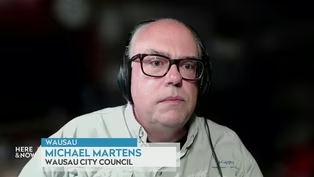
NewAlder Michael Martens on Replacing Wausau's Lead Water Pipes
Video has Closed Captions
Clip: S2500 Ep2513 | 6m 2s | Michael Martens on Wausau's goal to remove and replace lead services lines before 2029. (6m 2s)
 New
NewHere & Now opening for September 25, 2026
Video has Closed Captions
Clip: S2500 Ep2513 | 1m 4s | The introduction to the September 25, 2026 episode of Here & Now. (1m 4s)
 New
NewThe Red Cliff Band and the Future of the Apostle Islands
Video has Closed Captions
Clip: S2500 Ep2513 | 6m 31s | Tribal leaders question a bill to redesignate the Apostle Islands National Lakeshore. (6m 31s)
 New
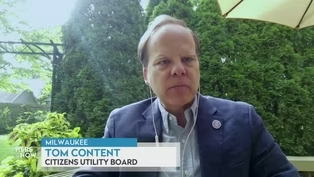
NewTom Content on Global Energy Prices and Winter Heating Costs
Video has Closed Captions
Clip: S2500 Ep2513 | 5m 38s | Tom Content on spikes in costs of heating fuels as utilities move to hike prices. (5m 38s)
 New
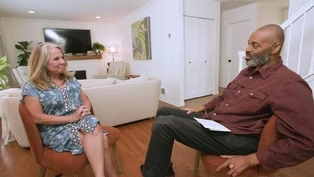
NewIn Focus with Wendi Dwyer: From Disability to Accessibility
Video has Closed Captions
Clip: S2500 Ep2513 | 49m 56s | Wendi Dwyer on work to increase empathy and access for people with disabilities. (49m 56s)
Providing Support for PBS.org
Learn Moreabout PBS online sponsorship New Episode
- News and Public Affairs

Top journalists deliver compelling original analysis of the hour's headlines.
 New Episode
- News and Public Affairs

Today's top journalists discuss Washington's current political events and public affairs.
 New Episode
 New Episode
 New Episode
 New Episode
 Recently Added
 New Episode
 New Episode

 New Episode
 New Episode
Support for PBS provided by:
Here and Now is a local public television program presented by PBS Wisconsin