Signature Dish
All Across Asia
Season 4 Episode 5 | 27m 28sVideo has Closed Captions
Yunnan by Potomac in Arlington, VA, Charga in Arlington, VA, Artha Rini in Kensington, MD.
Seth begins his flavorful pan-Asian journey at Yunnan by Potomac in Arlington, VA, savoring Norwegian King Crab Mixian, an elevated take on a Yunnanese comfort classic. Next, he stays in Arlington and stops in at Charga for their namesake dish: a Pakistani steamed and flash-fried chicken. He wraps up in Kensington, MD at Artha Rini, diving into Rawon, a rich and dark Indonesian beef soup.
Problems playing video? | Closed Captioning Feedback
Problems playing video? | Closed Captioning Feedback
Signature Dish is a local public television program presented by WETA
Signature Dish
All Across Asia
Season 4 Episode 5 | 27m 28sVideo has Closed Captions
Seth begins his flavorful pan-Asian journey at Yunnan by Potomac in Arlington, VA, savoring Norwegian King Crab Mixian, an elevated take on a Yunnanese comfort classic. Next, he stays in Arlington and stops in at Charga for their namesake dish: a Pakistani steamed and flash-fried chicken. He wraps up in Kensington, MD at Artha Rini, diving into Rawon, a rich and dark Indonesian beef soup.
Problems playing video? | Closed Captioning Feedback
How to Watch Signature Dish
Signature Dish is available to stream on pbs.org and the free PBS App, available on iPhone, Apple TV, Android TV, Android smartphones, Amazon Fire TV, Amazon Fire Tablet, Roku, Samsung Smart TV, and Vizio.
Providing Support for PBS.org
Learn Moreabout PBS online sponsorshipANNOUNCER: And now "Signature Dish," a WETA original series.
SETH: Today on "Signature Dish," we're on a journey all across Asia.
Oh, my sweet heavens.
We'll start with some supersized shellfish.
SHAO: This is a Norwegian king crab.
It's going to make the most tasty broth and the meat is the best crab you can get.
SETH: We'll dig into a South Asian standout.
IQBAL: That's my love, playing with flavor and spices.
SETH: This is just good street food eating.
And enjoy a tropical soup unlike any other.
Oh, that color of that paste, dark as night.
That is like nothing I've ever had.
I'm Seth Tillman, WETA producer and DC native, and I love good food.
Nice to meet you.
That's why I'm traveling to restaurants across the DMV.
At each stop, looking for the one thing you just gotta try... that Signature Dish.
We're starting our culinary tour in Arlington, Virginia.
Around the corner from the Pentagon City Metro is Yunnan By Potomac, which celebrates a lesser-known region of China.
SHAO: Yunnan is a region in Southwest China that's neighbored by Myanmar, Thailand, Laos, and Vietnam.
There's a lot of the Southeastern influences.
And that's where my mom is originally from.
Every culture has a soul food, something that feeds the people and warms the people and brings a sense of nostalgia.
So for Yunnan, it is mixian.
And mixian is a rice noodle.
It's the most ubiquitous food in Yunnan.
It's eaten for breakfast, lunch, and dinner.
And it's the obvious first place for us to start in telling a Yunnanese story.
But cooking traditional Yunnanese food is impossible for me.
I was born and raised in Wisconsin, and so I'm a Midwestern boy, and grew up eating a combination of Asian food and buttery Midwest food.
And so we brought in what we love.
A lot of what we love happens to be high-quality ingredients.
We also love to sous vide.
We love to reverse sear.
We love to do all of the stuff that speaks to elevated cooking and tells a more modern story.
I think it's along the same lines of wanting to represent for myself and my family, but also for Chinese American culture, that orange chicken and deep-fried foods don't define how we eat.
There's a lot of amazing Chinese and Asian chefs now who are all part of rewriting the story of what it means to be Chinese American.
And so I think that's our strength.
You're going to get great service when you come here.
You're going to get great food, but we hope to go beyond that, really let people feel a sense of belonging when they come here.
SETH: Shao.
SHAO: Hi, Seth.
SETH: Good to meet you.
SHAO: It's nice to meet you.
Welcome to Yunnan.
SETH: Oh, man.
Some big thick noodles in front of me right here.
What are you making today?
SHAO: So today we're going to make some mixian.
Mixian is a rice noodle made with non-glutinous rice flour.
Super fluffy, soft, airy.
SETH: And the airiness of these noodles, is that going to help them absorb a lot of flavors?
SHAO: Absolutely.
It absorbs the flavor without softening.
You can add any type of ingredient, any type of sauce, any type of broth.
We do seven different types of mixian here.
Today, we're going to make a really special mixian for you, and let me grab it for you.
SETH: All right.
Got a little bit of a surprise coming up?
SHAO: We do.
SETH: Oh my sweet heavens.
What is this, Shao?
SHAO: This is a live Norwegian king crab.
It's going to make the most tasty broth, and the meat is the best crab you can get.
We're going to steam him so that we can separate the meat from the shell.
Once we have all the good meat out and all the great head fat, we can begin making the rest of the dish.
SETH: I think I have seen it all now on Signature Dish.
How much do one of these Norwegian king crabs weigh?
SHAO: It depends.
Norwegian king crabs range from three to 12-15 pounds.
The best way to find out is to pick it up.
So why don't you do that and find out for yourself?
I would grab it by its three legs here, and the same on that side.
SETH: Oh my goodness.
[Seth chuckles] Everyone getting this?
I don't often come face-to-face with my own dinner.
Should I do the honors?
SHAO: Please.
SETH: All right.
Sorry about this guy.
Once the lid is on, Shao leaves the crab to steam until the meat is about halfway cooked.
After a quick ice bath to stop the cooking, we turn our attention to crab pickin'.
SHAO: Seth, so we're going to start on the back here, and right here, where the shell connects, is a little tendon.
We're going to snip that.
And now we can break open the head.
So here we have a lot of the fat, and we're going to pour that in here, and we'll add all of that to the broth.
Next, we're going to snip off these legs.
SETH: So, how is a Norwegian king crab different than an Alaskan king crab?
SHAO: They're actually the same species.
The Norwegian king crab comes from slightly cooler water, and the crab develops a little bit more fat in its body.
[shell cracks] SETH: Occupational hazard.
And how many dishes are you going to be able to get from a single crab like this?
SHAO: A large crab like this, we get about eight portions.
This crab costs a considerable amount of money, and so we want to get every gram of edible meat from the crab.
SETH: I thank you for letting me indulge in a little bit of luxury today.
As Shao continues to expertly clean the crab, he reserves the leftover shells for the broth.
Once we have the prized meat, it's time to get cooking on the mixian.
SHAO: All right, Seth, first, we're going to take one of our copper pots.
We have our crab head fat broth.
And so this has all of the shells, roasted leeks, and ginger, and a little bit of pork broth to give it a little depth of flavor.
So we're going to let this come up to a simmer, and then we're going to take some eggs, and we're going to whisk these in.
It's going to thicken the broth a little bit, and we'll do one egg white.
And we're going to start whisking as this comes up to temp.
We can move it to the side a little bit.
We have our warmed-up butter.
We're going to take this crab, and we're just going to warm it up again.
SETH: Got a nice steam bath before, and now it's getting a little warm butter bath.
So we took good care of this crab today.
SHAO: Yes, it's been pampered.
As you can see, the butter is starting to bubble a little bit.
And so now we're at the assembly stage.
We have our mixian, and next I'm going to start putting in crab.
And now we have some butter-poached leeks.
Here we have some butter-poached shiitakes.
Everything's poached in butter for this dish.
That's where our cooking is a little bit different from traditional Yunnanese cooking.
Here I'm dropping in some butter-poached daikon, and we have some poached carrots here as well.
SETH: Let me guess, poached in butter.
SHAO: Actually, these are poached in broth.
SETH: Poached in broth.
All right.
SHAO: I just wanted to trick you a little bit.
And I'm going to drop on some scallion for good measure, and we're just going to drop some petals in.
We love using edible flowers.
Yunnan is a very ecologically rich area, and edible flowers are found in the cuisine all the time.
SETH: It's going to break my heart when we actually have to eat this.
SHAO: I'm going to grab one of our crab heads here, along with our kettle.
And this is gonna go right on top.
We're going to strain out some of the egg solids.
And we're going to pour the broth table-side for you.
SETH: All right, Shao.
The king crab show continues.
SHAO: Let me pour this for you.
We got a little extra broth here for when you're done.
SETH: All right.
Between the broth, the noodles, and the king crab, I don't know what I'm most excited about.
But I'm going to start with a little bit of that broth.
SHAO: Please.
SETH: All right, Shao.
Next level.
SHAO: Amazing.
SETH: Buttery and rich.
I got to try a little bit of the mixian.
I think I got a little crab in here as well.
SHAO: That's a net win.
SETH: We're getting into luxury mode now.
The crab was so tender, and those noodles, they're springy, but they're also really soft and delicate.
SHAO: We love mixian because it is great at soaking up the flavor, and it's a great compliment to all of the other textures in the bowl.
SETH: Mmm, but of course, there's a big ol' king crab claw.
SHAO: Yes.
SETH: I got to give it a shot.
I mean, what can you say?
I just love crab, and I think that little bath you gave it at the end with the hot butter just, you know, took it over the top.
SHAO: Seth, I grew up in Wisconsin, the dairy state.
And so this is a great example of how we can push the two food cultures together.
A little bit of butter or a lot of butter never hurts anything.
SETH: It sure doesn't.
And getting one of those mushrooms that was poached in that butter, you have a little bit of earthy flavor and I think maybe browning the butter also brought out a little smokiness, too.
And I can see the drinks are clearly a big part of what you guys are doing here.
SHAO: Absolutely.
Seth, what you're having is called the gin blossom.
It's Japanese gin that's been clarified with blackberry shrub.
Here I have our lychee margarita, equal parts mescal and tequila, and also it's been clarified.
Cheers.
SETH: Fun times.
Cheers, Chef.
Mmm, delicious.
And clarifying your cocktails, emulsifying this broth, adding things like king crab, clearly a pretty forward-thinking restaurant right here.
SHAO: We're trying to build something that is long-lasting, something that can add to the fabric of what Asian American food really means here.
And if we don't continuously push ourselves to evolve, time will go on and we will find ourselves behind.
SETH: Well, I'm glad you're applying your creative talents right here in Northern Virginia.
This dish was just impressive from start to finish.
SHAO: Thank you, Seth.
SETH: And after the cameras stop, I'm going to sit right here and finish the rest.
Thank you so much, Shao.
SHAO: Thank you, Seth.
SETH: For my next stop, I'm staying in Arlington.
In a shopping plaza along Langston Boulevard, you'll find Charga Grill, run by Pakistani American owner Asad Chaudry, along with his Uncle Iqbal.
ASAD: So 2012, I went to Pakistan for my brother's wedding, and we were in Lahore.
I was born in Queens.
When I first saw Lahore, it reminded me of like New York City.
Everybody's up all late at night, and people were eating food till like 2:00, 3:00 in the morning.
IQBAL: Lahore is a very busy city.
You're going to see all the carts coming right on the street, doing all kinds of crazy street food.
ASAD: And you got one section they're making naans, another section they're making kebabs.
And I got introduced to charga.
Charga was a steamed and flash-fried chicken they make right on the street.
It was really tender, juicy, flavorful.
When I came out here, you know, nobody was doing charga.
So 2019, we started Charga Grill.
SETH: Iqbal, who simply goes by Uncle D, cooks up the restaurant's signature charga, along with street foods from across the globe.
ASAD: D is one of the best chefs I ever worked with in my life.
This guy speaks like five, six different languages.
He does some of the best Peruvian dishes I ever had, Mexican dishes I ever had.
You name it, he make it.
IQBAL: I have done basically all kinds of food from all over.
I don't follow their recipes.
I come up with my own, which is better than the original recipe, honestly.
ASAD: The community really loves our food.
They love our kebabs, and they love our chicken.
We are a little hole-in-the-wall spot, but our food has a story behind it and our food has flavor behind it.
So when people come here, they really get a taste of back home.
SETH: Chef, good to meet you.
IQBAL: How you doing?
Good to meet you.
SETH: I am doing great and excited about some Pakistani street food.
What are you making?
IQBAL: We're making a charga.
Charga is a street food from Lahore, Pakistan.
SETH: Charga... IQBAL: Which is a steamed and flash-fried chicken.
What I did is... Then we slit the chicken.
That helps to absorb all the spices.
We do a 40-minute process, streaming that chicken to hold all the juices in.
SETH: All right, so this chicken has been steamed and now it's time to add all the flavors.
IQBAL: We're going to do all the flavors.
I'm going to pour a homemade yogurt right here.
SETH: Homemade yogurt.
IQBAL: A homemade yogurt.
And now here we're going to start from the salt.
We got a black pepper.
Doing a ginger garlic paste, which is a home-grind ginger garlic paste.
Lemon juice.
Okay, here we go.
We got the turmeric right here.
Now we're going to do a cumin powder, which is a home-grind cumin powder.
SETH: You're a man who loves his spices.
IQBAL: Absolutely.
The Pakistani food is full of different spices.
We got the chili powder.
Adding a turmeric and a chili powder gives you the charga color.
Here, we got a coriander powder.
Finally, we're going to add our secret spice, which is a Pakistani allspice.
SETH: You saved the secret ingredient for last.
IQBAL: That's the rule is.
It has seven whole different spices.
We grind at home.
SETH: Grind it at home to keep prying eyes away from the kitchen?
IQBAL: Absolutely.
SETH: Keep your secret carefully gardened.
IQBAL: That's the reason why we're doing it right now.
We're going to mix all the spices together right here with the homemade yogurt.
SETH: This is a dish that you would find everywhere in Lahore?
IQBAL: Everywhere, any street you'll find charga.
They don't serve in a plate.
SETH: They just hand it to you?
IQBAL: They hand it to you in a day before newspaper.
That's the rule is.
SETH: Hand it to you so you can just start eating.
IQBAL: Absolutely.
Now here you go.
We're going to work on our whole steamed chicken.
I'm going to split the chicken into four quarters now.
And this chicken goes into our marinade we just made.
SETH: It might be the homemade yogurt, but that marinade is sticking really nicely to that chicken right there.
IQBAL: You said it's sticking right now.
Just wait till it comes out after 24 hours.
The chicken absorbs all the spices, it goes inside the chicken.
Now we're going to go ahead and set the chicken for 24 hours, but this is how it comes out, the finished product.
SETH: Oh yeah.
It has coated it so nicely and just completely transformed the look of that chicken.
IQBAL: Okay, Seth, the final step of the process is we're just going to drop it in the fryer for 40 seconds.
(sizzle) The reason we're doing a flash fry is cook the spice and get that crisp outside.
When it's ready to serve, we garnish with the sliced red onion and chopped cilantro.
We got to top it with our house chaat masala.
And you'll be ready to eat.
That's the charga.
SETH: All right, D, Asad.
There is an explosion of colors and aromas coming off this plate.
I cannot wait to try the rice and the chickpeas, but I'm going straight for that charga.
IQBAL: Please.
SETH: Mmmm.
IQBAL: How do you like it?
SETH: Oh man.
That is fire right there.
Those flavors have absorbed all the way through.
Nice and bold spices.
And that flash fry, you know I don't think I've ever had fried chicken without the skin on before.
That's usually my favorite part.
But the outside does get so nice and crisp while the meat is still so nice and juicy on the inside.
And I'm guessing with all this naan and chickpeas and rice, is there a good way to go about trying to get all these flavors together in one bite?
ASAD: Honestly, you should try taking a piece of the naan off and take a piece of chicken and put some chutney on top of it.
SETH: All right.
Get a little bit of a raw onion in there, too.
What's this chutney right here?
ASAD: It's a mint chutney.
It goes really well with the chicken in it.
SETH: Yeah.
The red onion hits you a little bit, but then the mint chutney cools it right back down.
ASAD: Definitely.
SETH: This is just good street food eating right here at Charga.
IQBAL: It is.
SETH: And these chickpeas are just calling my name.
IQBAL: Absolutely.
How I do my chickpeas is I soak overnight, and then I cook through, it gets tender.
Then my own spice.
SETH: Well, if you could have flavor for days, but the texture, just how they melt in your mouth too.
And it looks like we're just celebrating chicken in all forms here.
What's happening on this platter here?
ASAD: So first is the one you tried.
This is a charga.
Right next to it, it's a rotisserie chicken.
It's from Baluchistan part of Pakistan.
And then right over there, the leg and thigh is an Indian-style chicken tandoori.
And right next to that is our peri-peri chicken, which is made for spice lovers.
SETH: You a spice lover, chef?
IQBAL: I am a spice lover.
That's on my level, though.
SETH: And we're talking peri-peri, so we're going to a whole other hemisphere right here.
ASAD: Oh yeah.
SETH: Is all the heat in the sauce right on top?
IQBAL: All in sauce.
Don't take a big bite, though.
ASAD: I would be careful.
IQBAL: Take a small bite.
SETH: This happens all the time.
A chef warns me to take a small bite, and then I take way too much.
IQBAL: You got to take a small bite.
SETH: I like spice, but that is intense.
ASAD: You definitely wash it down with the mango lassi.
It'll calm it down a little bit.
SETH: All right.
Mango lassi to the rescue.
And you know, Asad, for you, someone who didn't grow up in Pakistan, has this connected you a little bit more with your roots?
ASAD: Absolutely.
It definitely brought me closer to the community.
Growing up, I spoke Urdu, but my Urdu got way better, fell more in love with the culture and the food.
It definitely brought me back to my roots.
SETH: Well, it's amazing what food can do to connect people.
And I think the spice in that peri-peri is finally wearing off a little bit.
So maybe I can go back in.
IQBAL: Look at you, you start sweating.
[laughter] SETH: I love all these homemade, vibrant flavors.
Thanks for taking me on a little tour around Pakistan and beyond.
I can't wait to come back.
Thank you, guys.
IQBAL: Thank you, Mr.
Seth.
ASAD: Thank you so much.
SETH: To wrap things up, I'm heading off to Kensington, Maryland.
Near the heart of Antiques Row is Artha Rini, a tiny mom-and-pop offering a vibrant taste of Indonesia.
The restaurant is run by and named for chef Artharini, who first came to the US when her husband, Wirawan, accepted a job in DC.
ARTHARINI: I was born in Semarang, that's in Central Java, and I grew up with my adoptive parents, and they have catering company.
So, our family love cooking, so I love cooking too.
When I came here, I cannot just sit down.
So what I can do?
So I try cooking.
SETH: After years of running a home catering business and cooking for embassies and foreign dignitaries, Artharini decided to open her own restaurant in 2023.
Wirawan quit his job and now waits tables and manages the front of house.
WIRAWAN: My dreams, I want to have the restaurant.
And then I know my wife good for the cooking.
This why I think if we join together, this is good.
ARTHARINI: He love talk to the customer.
He love telling the story.
He loves asking the customer and then telling about the food.
WIRAWAN: Indonesia, you know, they have 38 state.
We have more than 17,000 islands, and in every island we have different food.
...they're very happy because they look like at home.
ARTHARINI: When they coming, they can see Indonesia here, not only the taste of food, but feel like home.
Not a lot of people know about Indonesian food.
So when they eat it and then they told me, "Oh, this is good.
Oh, this is so delicious.
I will come back," just make me happy and proud myself.
SETH: I'm visiting Artharini at her namesake restaurant to try a treasured dish from her home in Java.
Artharini.
ARTHARINI: Hi.
How are you?
SETH: Nice to meet you.
ARTHARINI: Nice to meet you, too.
SETH: Thank you so much for welcoming me.
And I see some very unique-looking ingredients that I'm not sure I've ever seen anywhere else before.
What are you making today?
ARTHARINI: Today, we will make a soup.
In East Java, we call it rawon, but here we call it black soup because there's the color black in the soup.
SETH: Yes.
There are some very dark ingredients in front of me here.
And what is it that makes this soup a black soup?
SETH: Cyanide?
ARTHARINI: Yes, so... SETH: This would kill me.
But not today, not today, not today.
I need to be able to taste the soup.
ARTHARINI: It's edible, it's edible.
SETH: So this one's not going to kill me.
ARTHARINI: No.
SETH: Okay.
ARTHARINI: No, no.
SETH: Oh, and a really nice aroma too.
Almost like a chocolate in a way.
ARTHARINI: Totally.
SETH: To my nose.
How does the Keluak nut get into the soup itself?
ARTHARINI: So I will soak in the water until soft, and then we will blend it with the bumbu.
So we have bumbu that everything we cook.
SETH: So this is kind of like your sofrito or your mirepoix.
This is the base of everything else.
ARTHARINI: Yeah, this the base.
The white bumbu we blend with the Keluak, the black nut, until this paste.
SETH: Oh, that color of that paste, dark as night.
That is a thing of beauty.
ARTHARINI: Now we start cooking the soup.
...in the oil.
First, I put lemongrass here.
And then that's a bay leaf.
Bay leaf Indonesia and bay leaf here, that's different.
I love using the kaffir lime.
There's like a citrus smell and then the lemongrass too, the smell good.
SETH: Oh, absolutely.
I can just hover over this pot all day long.
Time for the bumbu?
ARTHARINI: Yes.
SETH: You got a lot of flavor to get into the soup here.
ARTHARINI: We mix.
SETH: It's an aromatic explosion in this kitchen right now, Chef.
ARTHARINI: And then we will add the coriander.
SETH: Beautiful.
SETH: All right, Chef, Wirawan.
I cannot wait to try this unique Javanese soup.
I'm going to go in for a little bit of this broth first.
It's like no flavor- ARTHARINI: Do you like it?
SETH: Oh, do I like it?
That is wonderful.
There's a nuttiness, creaminess, a little bit of bitterness, I guess, from the Keluak nut.
Just a real nice savory depth of flavor.
That is like nothing I've ever had.
And there's some beef hiding out down here in the bottom, right?
ARTHARINI: Yes.
SETH: All right.
SETH: Just the beef.
Okay.
And this is all part of the dish too, right?
ARTHARINI: Yes.
SETH: All these sides.
ARTHARINI: There's rice, we have tapioca crackers, and then salted egg, and that's a potato fritter.
SETH: You recommend trying to take a little bite of rice with the soup?
ARTHARINI: Yes.
So we mix it and then we eat it.
SETH: Mmm, and tell me about this unusual-looking egg here.
WIRAWAN: Yeah, this is the salted egg.
SETH: Just break the shell or go right in the scoop it up?
WIRAWAN: Just scoop it up.
SETH: All right.
Here we go.
ARTHARINI: You have to scoop all.
SETH: I'll try my best.
That is indeed a salty egg.
ARTHARINI: So you scoop the egg and then put in the soup and then eat a little bit.
SETH: Ah, all right.
ARTHARINI: I'm so sorry.
SETH: No.
All right.
ARTHARINI: I'm so sorry.
SETH: It's okay.
This is my first Indonesian dining experience, so I'm sure I'm going to do just about everything wrong.
And speaking of doing things wrong, I'm sure I'll probably end up putting a little too much spiciness on my food.
But these are different kinds of I'm going to guess hot sauces?
ARTHARINI: Yeah.
So this is sambal soto.
That's only chili and garlic.
And then this is the sambal terasi.
That's come with chili paste.
And then this is sambal ijo.
That's from the jalapeño and garlic.
SETH: Which one's your favorite?
WIRAWAN: For the rawon, you must try the sambal terasi.
SETH: Okay, obviously, I'm not going to try to eat this.
This goes into the soup, right?
WIRAWAN: Yeah.
ARTHARINI: But not... SETH: Not too much?
WIRAWAN: Indonesia, there's a lot of the sambal.
SETH: Is it hard trying to represent a country as diverse as Indonesia in one small restaurant?
WIRAWAN: We try to put the popular one in the state, like this rendang, very popular in the Sumatra, this tahu gejrot is popular in west of Java.
This is gudeg from the center of Java.
SETH: You can't get to all of Indonesia yet, but you're making your way there.
WIRAWAN: Yeah.
SETH: And then the whole restaurant.
I mean, everywhere you look around you, there's masks and artifacts.
I really feel like I've stepped into somewhere else here.
ARTHARINI: Yes, like our home.
WIRAWAN: Yeah.
SETH: Well, thank you so much for welcoming me into your home... ARTHARINI: You're welcome.
SETH: ...and for making this incredible rawon.
I can't wait to come back and try it again.
ARTHARINI: Thank you so much.
WIRAWAN: Thank you so much.
(music plays through credits) ANNOUNCER: To find out more about great food in the Washington Metro area, visit weta.org/signaturedish.
 New
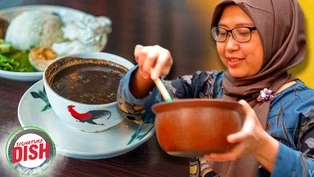
NewThe "Deadly" Secret Ingredient in Indonesian Soup Rawon: Cooking with the Keluak Nut at Artha Rini
Video has Closed Captions
Clip: S4 Ep5 | 5m 1s | Host Seth Tillman visits Indonesian restaurant Artha Rini to learn the art of making Rawon. (5m 1s)
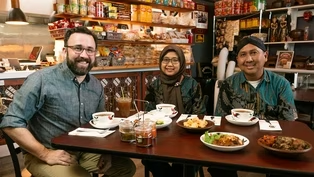
Preview: S4 Ep5 | 30s | Yunnan by Potomac in Arlington, VA, Charga in Arlington, VA, Artha Rini in Kensington, MD. (30s)
 New
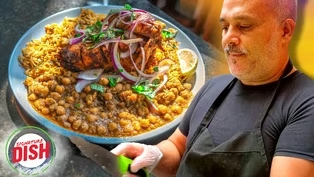
NewWatch Charga Grill Make Lahore’s Iconic Street Food: Juicy, Crispy Chicken That's Packed with Flavor
Video has Closed Captions
Clip: S4 Ep5 | 5m 6s | Host Seth Tillman visits Charga Grill in Arlington to learn about Pakistani street food charga. (5m 6s)
 New
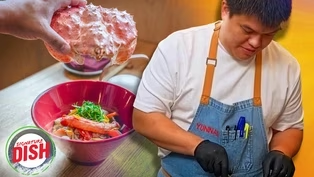
NewWatch Yunnan Make Chinese Rice Noodles with King Crab and a Dose of Midwestern Flavor
Video has Closed Captions
Clip: S4 Ep5 | 6m 6s | Seth Tillman heads to Yunnan to sample their take on a Mixian, a Chinese rice noodle dish. (6m 6s)
Providing Support for PBS.org
Learn Moreabout PBS online sponsorship
- Food
Christopher Kimball’s Milk Street Television
Transform home cooking with the editors of Christopher Kimball’s Milk Street Magazine.







Support for PBS provided by:
Signature Dish is a local public television program presented by WETA